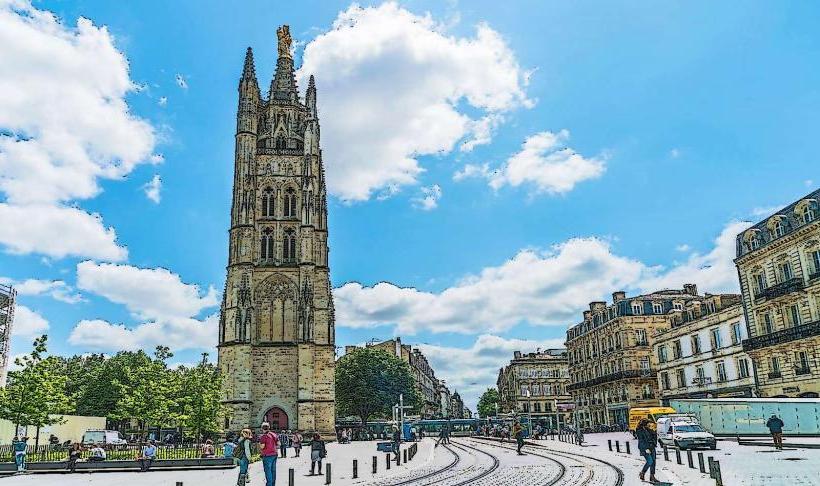
Landmark: Saint Emilion Wine Region
City: Bordeaux
Country: France
Continent: Europe
Saint Emilion Wine Region, Bordeaux, France, Europe
The Saint-Émilion Wine Region is a world-renowned viticultural area located on the Right Bank of the Dordogne River, approximately 40 kilometers east of Bordeaux. It is a UNESCO World Heritage site, recognized as a "cultural landscape" for its continuous wine production spanning nearly 2,000 years.
Visual Characteristics
The landscape is defined by rolling limestone plateaus and gentle slopes covered in a dense grid of vineyards. At its center lies the medieval village of Saint-Émilion, a cluster of golden limestone buildings with terracotta roofs. The visual signature of the region includes its "monolithic" structures-buildings carved directly into the rock-and the prominent spire of its 12th-century church.
Location & Access Logistics
Coordinates: 44°53′N 0°09′W.
From Bordeaux: Approximately 45 minutes by car via the N89.
Transit: Direct TER trains run from Bordeaux Saint-Jean to the Saint-Émilion station (approx. 35 minutes). The station is a 1.5km uphill walk from the village center.
Parking: Limited inside the village. Large lots are located at the Espace Guadet (North) and at the foot of the village (South).
Historical & Ecological Origin
The region’s name originates from a 12th-century monk named Émilion who settled in a hermitage here. Geologically, the area is unique for its Asteria limestone substrate, which provides excellent drainage and imparts specific mineral qualities to the grapes. The climate is oceanic-continental, moderated by the Dordogne and Isle rivers.
Viticulture & Classifications
The region specializes in Merlot-dominant blends, typically balanced with Cabernet Franc and smaller amounts of Cabernet Sauvignon.
Classification: Unlike the fixed 1855 Bordeaux classification, the Saint-Émilion classification is revised roughly every 10 years.
Tiers: The top designations are Premier Grand Cru Classé (A and B) and Grand Cru Classé.
Terroir: The region is divided into three zones: the limestone plateau, the clay-limestone slopes (côtes), and the sandy-gravel plains.
Key Highlights & Activities
Monolithic Church: The largest underground church in Europe, carved entirely out of a single limestone block in the 12th century.
The King’s Keep (Tour du Roy): A 13th-century citadel tower offering panoramic views of the vineyards.
Wine Tasting: Numerous "Maisons du Vin" and individual châteaux (e.g., Château Ausone, Château Cheval Blanc) offer tours of their limestone cellars.
Cloisters: The Cordeliers Cloister, where sparkling wine (Crémant de Bordeaux) is aged in underground galleries.
Infrastructure & Amenities
The village is densely packed with wine boutiques and high-end restaurants. 5G coverage is reliable in the village, though signal drops significantly within the underground cellars and tunnels. The village terrain is exceptionally steep and paved with old cobblestones, making it challenging for those with limited mobility.
Best Time to Visit
September and October are optimal to witness the harvest (Vendanges). May and June offer mild weather and the first vine flowering. Note that the village is extremely crowded on weekends during the summer.
Facts & Legends
A verified historical oddity is the presence of 200 kilometers of underground tunnels beneath the vineyards, created by centuries of limestone quarrying. Legend states that the chair in Saint-Émilion’s original hermitage cave has fertility powers for women who sit upon it.
Nearby Landmarks
Libourne: 8km West
Pomerol Wine Region: 5km Northwest
Château de Montaigne: 20km East
Dordogne River: 5km South