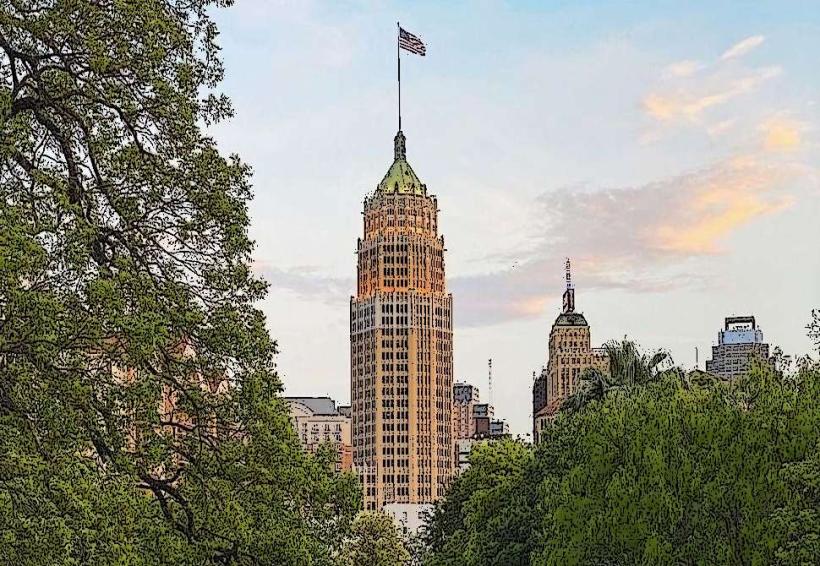
Landmark: San Antonio Missions National Historical Park
City: San Antonio
Country: USA Texas
Continent: North America
San Antonio Missions National Historical Park, San Antonio, USA Texas, North America
San Antonio Missions National Historical Park preserves four Spanish colonial missions located south of downtown San Antonio, Texas.
These sites represent a significant chapter in the history of Spanish colonization and the development of the region.
Visual Characteristics
The park comprises four distinct mission complexes: Mission Concepción, Mission San José, Mission San Juan, and Mission Espada. Each mission features a central church structure constructed primarily from local sandstone and limestone. The churches exhibit a Romanesque architectural style with rounded arches, barrel vaults, and bell towers. Exterior walls are typically plastered and whitewashed, with some areas showing exposed stone. Courtyard areas are enclosed by adobe walls and feature remnants of living quarters, workshops, and agricultural infrastructure. Vegetation within the park includes native grasses, mesquite trees, and various riparian plants along the San Antonio River.
Location & Access Logistics
The park is situated approximately 5 to 10 kilometers south of downtown San Antonio. Access is primarily via Mission Parkway, which connects the four main mission sites. Mission Concepción is located at 807 Mission Road. Mission San José is at 6539 San José Drive. Mission San Juan is at 9101 Graf Road. Mission Espada is at 10040 Espada Road. Parking is available at each mission site. Public transportation is provided by VIA Metropolitan Transit; Bus Route 40 serves Mission Concepción and Mission San José, while Bus Route 42 serves Mission San Juan and Mission Espada.
Historical & Ecological Origin
These missions were established by Spanish Franciscan missionaries in the early 18th century as part of a colonization effort to convert indigenous populations to Christianity and integrate them into Spanish society. Mission Concepción was founded in 1716, San José in 1720, San Juan in 1731, and Espada in 1690. The park's location along the San Antonio River is part of the larger Edwards Aquifer watershed, a vital ecological system supporting diverse plant and animal life.
Key Highlights & Activities
Visitors can explore the historic church structures, examine the preserved living quarters and workshops, and walk the grounds of each mission. Ranger-led interpretive programs are offered at various times. Cycling along the Mission Reach section of the San Antonio River is a popular activity, connecting the four missions. Self-guided walking tours are available at each site. Photography of the architectural details and surrounding landscape is permitted.
Infrastructure & Amenities
Restrooms are available at all four mission sites. Shaded areas are provided by trees and some covered structures. Cell phone signal (4G/5G) is generally available throughout the park. Food vendors are not present within the park boundaries, but are available in nearby commercial areas. Water fountains are located at Mission San José and Mission Concepción.
Best Time to Visit
The best time of day for photography is generally in the morning or late afternoon when the sun angle creates distinct shadows on the stone structures. The most favorable months for visiting are March through May and September through November, offering moderate temperatures. High tide is not a relevant factor for visiting these terrestrial sites.
Facts & Legends
Mission San José is known as the "Queen of the Missions" and features a highly ornate rose window on its church, though the original window was likely much simpler. A local legend suggests that the ghost of a friar can sometimes be seen wandering the grounds of Mission Espada at dusk.
Nearby Landmarks
- The Alamo (2.5km North)
- Tower of the Americas (4.0km North)
- Yanaguana Garden (3.5km North)
- San Antonio River Walk (3.0km North)
- King William Historic District (3.0km North)