Information
Landmark: Yonghe LamaseryCity: Beijing
Country: China
Continent: Asia
Yonghe Lamasery, Beijing, China, Asia
Yonghe Lamasery is a Tibetan Buddhist monastery located in the Dongcheng District of Beijing, China.
It is one of the largest and most important Tibetan Buddhist monasteries in Beijing.
Visual Characteristics
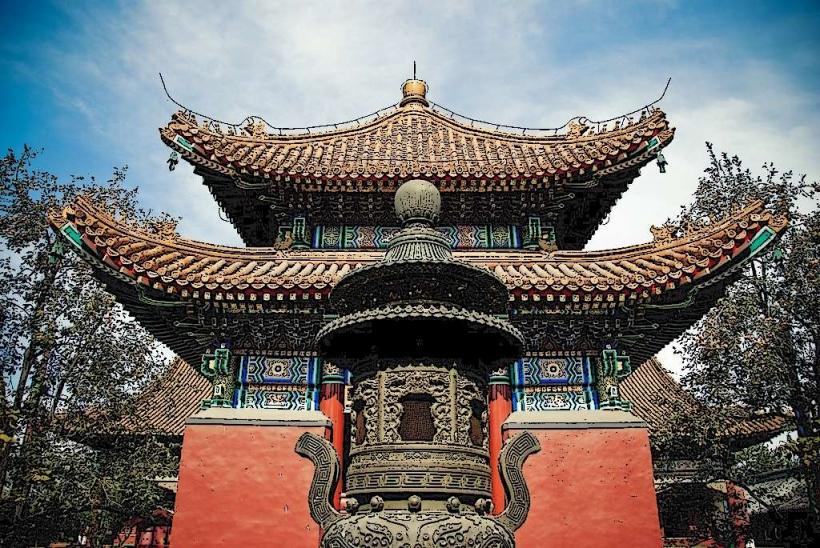
The lamasery complex covers an area of 66,400 square meters. It features a symmetrical layout along a north-south axis, typical of Han Chinese imperial architecture. The main structures include the Great Hall of Harmony and Peace, the Hall of the Dharma Wheel, and the Hall of Ten Thousand Joys. The architecture blends Han Chinese and Tibetan styles, with red walls, yellow tiled roofs, and intricate carvings. The central structure is the Pavilion of the Great Happiness, housing a 26-meter tall Maitreya Buddha statue carved from a single block of sandalwood.
Location & Access Logistics
Yonghe Lamasery is situated at 12 Yonghegong Street, Dongcheng District, Beijing. It is approximately 4 kilometers northeast of Tiananmen Square. The nearest subway station is Yonghegong Lama Temple Station, served by Subway Line 2 and Line 5. Several bus lines also stop nearby, including routes 13, 684, and 116. Parking is limited in the immediate vicinity; visitors arriving by private vehicle should utilize designated public parking areas several blocks away.
Historical & Ecological Origin
Originally constructed in 1694 during the Qing Dynasty, Yonghe Lamasery served as a residence for Prince Yong (later Emperor Yongzheng). In 1744, it was converted into a Tibetan Buddhist lamasery and became the foremost center for Tibetan Buddhism in Beijing. The complex was rebuilt and expanded over subsequent decades. It is not a natural site, therefore ecological origin is not applicable.
Key Highlights & Activities
Visitors can observe the architectural styles of the various halls and courtyards. The sandalwood Maitreya Buddha statue in the Pavilion of the Great Happiness is a primary point of interest. Photography is permitted in most outdoor areas, but restricted inside certain halls. Guided tours are available, providing historical context and explanations of Buddhist iconography. Observing monks performing daily rituals, when permitted, offers insight into monastic life.
Infrastructure & Amenities
Restrooms are available within the complex. Shaded areas are provided by the buildings and trees. Cell phone signal (4G/5G) is generally good throughout the site. Food vendors and small restaurants are located on Yonghegong Street outside the lamasery entrance.
Best Time to Visit
The best time of day for photography is generally in the morning or late afternoon when the sunlight casts longer shadows and illuminates the structures. The months of April, May, September, and October offer pleasant weather conditions with moderate temperatures. There are no tide-related considerations for visiting.
Facts & Legends
The 26-meter tall Maitreya Buddha statue was carved from a single block of sandalwood sourced from Tibet. It took three years to carve and transport to Beijing. A local legend suggests that the statue's immense size and the effort involved in its creation were intended to demonstrate the emperor's devotion and the power of Tibetan Buddhism.
Nearby Landmarks
- Guozijian (Imperial Academy) - 0.3km Northwest
- Confucian Temple - 0.3km Northwest
- Temple of the Earth - 1.2km East
- Nanluoguxiang - 1.5km Southwest
- Houhai Lake - 2.0km Southwest