City: Wurzburg
Country: Germany
Continent: Europe
Wurzburg, Germany, Europe
Würzburg is a city in the Franconia region of northern Bavaria, situated on the Main River. It is the center of the Franconian wine industry and serves as the northern gateway to the "Romantic Road."
Visual Characteristics
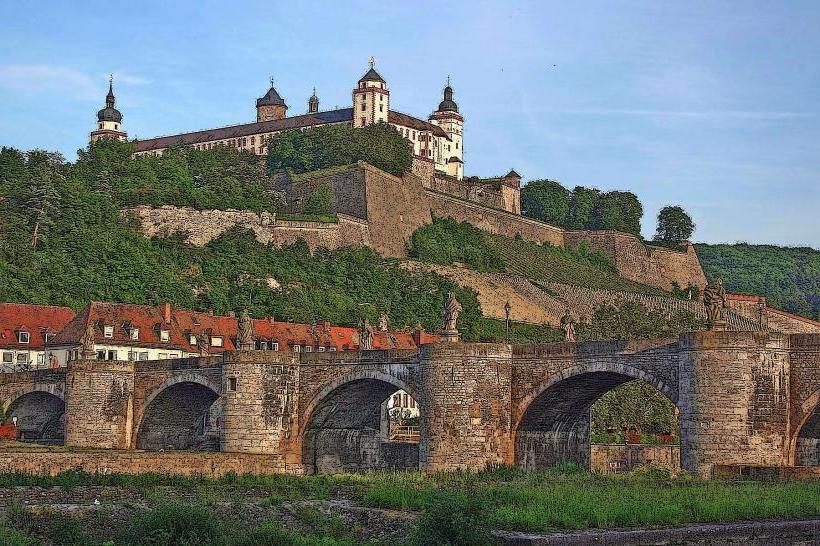
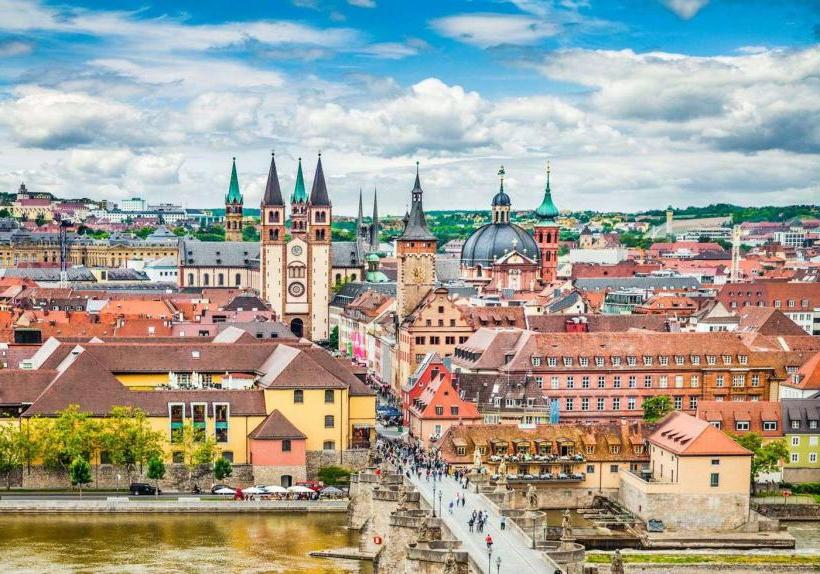
The urban landscape is defined by the Würzburg Residence, a Baroque palace complex utilizing yellow sandstone. The skyline features the Marienberg Fortress (Festung Marienberg), a massive stone fortification on a vineyard-covered hill. The Old Main Bridge (Alte Mainbrücke) is characterized by twelve monumental stone statues of saints and kings. Architecture in the core is primarily reconstructed Baroque and Rococo, following the city's significant destruction in 1945.
Location & Access Logistics
Würzburg is located 120 kilometers east of Frankfurt and 110 kilometers west of Nuremberg. It is served by Würzburg Hauptbahnhof, a major rail junction for ICE high-speed lines connecting Hamburg/Hanover to Munich and Frankfurt to Vienna. The VVM transit network operates five tram lines and an extensive bus system. Vehicle access is via the A3, A7, and A81 motorways. Public parking is concentrated in the large "Residenzplatz" lot and the "Mainfranken-Theater" underground garage.
Historical & Ecological Origin
Originally a Celtic settlement, Würzburg became a Prince-Bishopric in the 8th century. It was the site of the first university in Bavaria (1402). Geologically, the city sits in a valley of "Muschelkalk" (shell limestone), which provides the mineral-rich soil required for the Silvaner and Riesling grapes of the region. The city is famous for the "Bocksbeutel," a distinctive flattened ellipsoidal wine bottle used specifically for Franconian wines.
Key Highlights & Activities
The Würzburg Residence is a UNESCO site accessible for viewing the world's largest ceiling fresco by Giovanni Battista Tiepolo. The Court Gardens (Hofgarten) feature high-density Rococo sculpture and manicured flora. Visitors can walk the Old Main Bridge to engage in "Brückenschoppen," the local tradition of drinking Franconian wine while standing on the bridge. The Marienberg Fortress houses the Museum for Franconia, containing the world’s largest collection of works by sculptor Tilman Riemenschneider.
Infrastructure & Amenities
The city center is equipped with public restrooms near the Market Square (Marktplatz) and the Residence. 5G cellular coverage is universal. The "VAG_Rad" sharing system provides automated bicycle rentals. Drinking water fountains are available in the pedestrian zones during summer. Retail and dining are concentrated in the area between the Cathedral (Dom) and the Market Square, with high concentrations of traditional "Weinstuben" (wine taverns).
Best Time to Visit
The climate is temperate continental. May through September is optimal for visiting vineyards and outdoor festivals, with temperatures between 18°C and 25°C. The Würzburg Wine Festival in late summer and the Mozart Festival in June are primary cultural draws. Photography of the Fortress from the Old Main Bridge is best at sunset. Winters are cold, featuring a Christmas market on the Marktplatz.
Facts & Legends
Würzburg is where Wilhelm Conrad Röntgen discovered X-rays in 1895 at the University of Würzburg. A local historical oddity: the city’s Juliusspital is the second-largest winery in Germany and has functioned as both a hospital and a wine estate since 1576. Legend holds that the three martyrs Kilian, Kolonat, and Totnan were killed here for trying to convert the local Duke to Christianity, leading to the city's establishment as a major pilgrimage site.
Nearby Landmarks
Würzburg Residence: Central hub (East)
Old Main Bridge: 0.5km West of Residence
Marienberg Fortress: 1.2km West (across the river)
St. Kilian Cathedral: 0.3km West of Residence
Market Square: 0.4km Northwest of Residence