Landmark: Aghlabid Basins
City: Kairouan
Country: Tunisia
Continent: Africa
Aghlabid Basins, Kairouan, Tunisia, Africa
The Aghlabid Basins are a complex of large water reservoirs located on the outskirts of Kairouan, Tunisia.
These structures were engineered to collect and store rainwater for the city's population.
Visual Characteristics
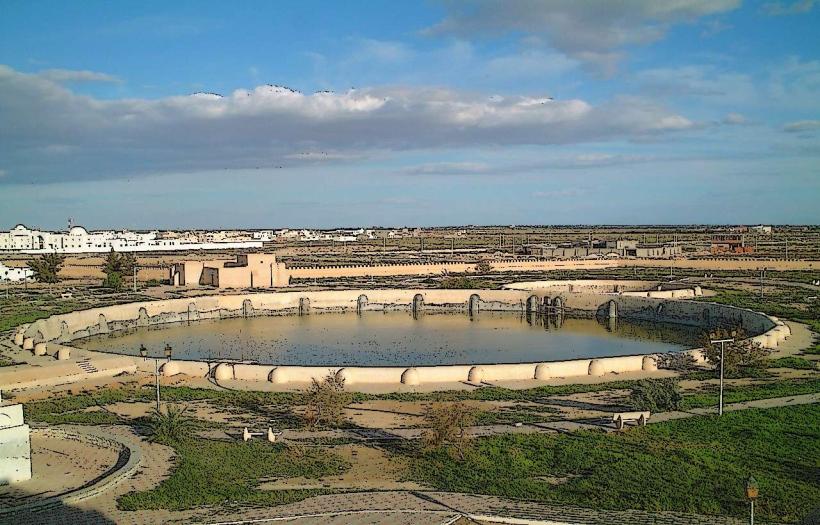
The basins are circular and rectangular in shape, constructed from stone and mortar. They vary in size, with the largest measuring approximately 128 meters in diameter and 10 meters in depth. The exterior walls are thick and robust, designed for water retention. Vegetation is sparse around the immediate vicinity of the basins.
Location & Access Logistics
The Aghlabid Basins are situated approximately 2 kilometers west of Kairouan's city center. Access is via the P19 road, turning off towards the basins. Ample unpaved parking is available adjacent to the main structures. Public transport options directly to the basins are limited; a taxi or private vehicle is recommended.
Historical & Ecological Origin
Construction of the basins began in the 9th century CE, under the rule of the Aghlabid dynasty. They were designed by Aghlabid engineers to address the chronic water scarcity in Kairouan, which was then a significant religious and administrative center. The system collected runoff from the surrounding arid landscape.
Key Highlights & Activities
Visitors can observe the scale and engineering of the reservoirs. Walking along the perimeter of the larger basins is possible. Photography of the architectural design and the surrounding landscape is a primary activity. Interpretive signage provides historical context.
Infrastructure & Amenities
Basic restroom facilities are located near the main entrance. Limited shade is available from the structures themselves. Cell phone signal (4G) is generally available. No on-site food vendors are present; visitors should bring provisions.
Best Time to Visit
For optimal lighting for photography, early morning or late afternoon provides angled sunlight that highlights the basin's contours. The best months for visiting are typically from October to April, avoiding the extreme heat of summer. Rainfall is infrequent but essential for the basins' historical function.
Facts & Legends
A specific historical detail is that the largest basin, known as the Grand Bassin, could hold an estimated 30,000 cubic meters of water. Local lore sometimes speaks of the ingenuity of the engineers who devised such a system in a challenging environment.
Nearby Landmarks
- Great Mosque of Kairouan (1.5km East)
- Barberousse Mausoleum (1.8km East)
- Aghlabid Mosque (1.6km East)
- Kairouan Medina (2km East)