Landmark: Bremen Town Hall
City: Bremen
Country: Germany
Continent: Europe
Bremen Town Hall, Bremen, Germany, Europe
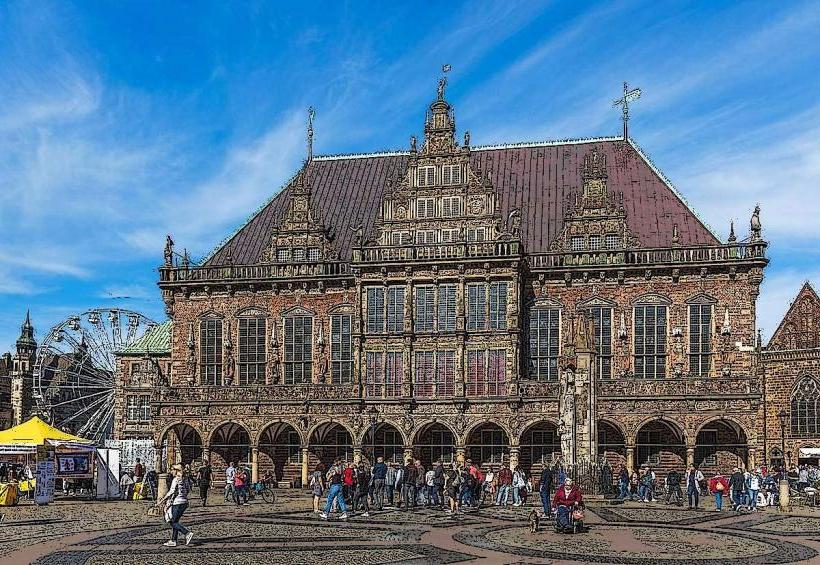
Bremen Town Hall (Bremer Rathaus) is a Gothic and Weser Renaissance structure and one of the most important examples of civic architecture in Europe. It is a UNESCO World Heritage site.
Visual Characteristics
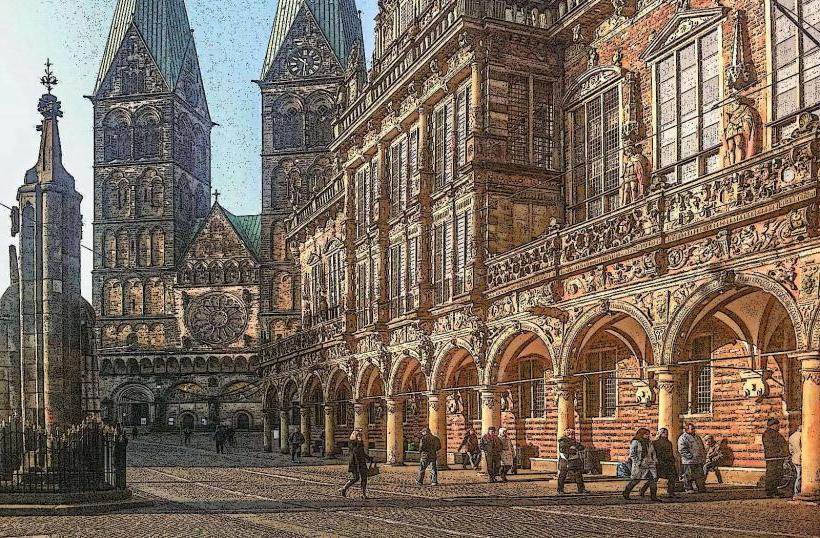
The building features a 15th-century brick Gothic core with a 17th-century Weser Renaissance facade. The facade is highly decorative, characterized by large windows, gables, and stone sculptures depicting the Holy Roman Emperor and the seven prince-electors. The copper-clad roof has weathered to a distinctive green.
Location & Access Logistics
Located at Am Markt 21, 28195 Bremen.
Public Transit: Served by Tram lines 2, 3, 4, 6, 8 at the Domsheide or Obernstraße stops.
Access: The exterior is visible 24/7. Access to the interior (Upper Hall, Golden Chamber) is available only through official guided tours.
Hours: Guided tours usually held Mon–Sat at 11:00 AM, 12:00 PM, 3:00 PM, and 4:00 PM; Sun at 11:00 AM and 12:00 PM.
Parking: Use "Parkhaus Pressehaus" or "Parkhaus Mitte."
Historical Origin
The "Old Town Hall" was built between 1405 and 1410 in Gothic style. Between 1608 and 1612, architect Lüder von Bentheim renovated the market-facing side in the Weser Renaissance style to reflect the city's economic prosperity. A modern "New Town Hall" extension was added in 1913. It is one of the few medieval town halls in Europe never destroyed or significantly damaged in WWII.
Key Highlights & Activities
Upper Town Hall (Obere Rathaushalle): A massive hall featuring model ships with functional miniature cannons suspended from the ceiling.
Golden Chamber (Güldenkammer): A small, Art Nouveau-style room within the Upper Hall, redesigned by Heinrich Vogeler in 1905.
Bremen Town Musicians (Bremer Stadtmusikanten): Gerhard Marcks’ bronze statue of the donkey, dog, cat, and rooster, located on the western side.
Roland Statue: A 5.5-meter stone giant on the market square representing civic liberty; part of the UNESCO designation.
Bremer Ratskeller: A historic wine cellar beneath the town hall housing the world's largest collection of German wines.
Infrastructure & Amenities
The building is a functional government seat (office of the Mayor). Guided tours are wheelchair accessible via a lift. Public restrooms are located in the Ratskeller or nearby at the Domshof. 5G signal is robust.
Best Time to Visit
Weekdays: For a higher frequency of guided tours.
December: When the historic Christmas market is situated directly in front of the facade.
Facts & Legends
A technical oddity is the "Rose Cellar" in the Ratskeller, which contains the oldest cask-stored wine in Germany (dating to 1653). Legend states that touching both front legs of the donkey on the Town Musicians statue brings good luck-doing so with only one hand is locally mocked as "one donkey shaking hands with another."
Nearby Landmarks
Bremen Cathedral (St. Petri Dom) – Adjacent (East)
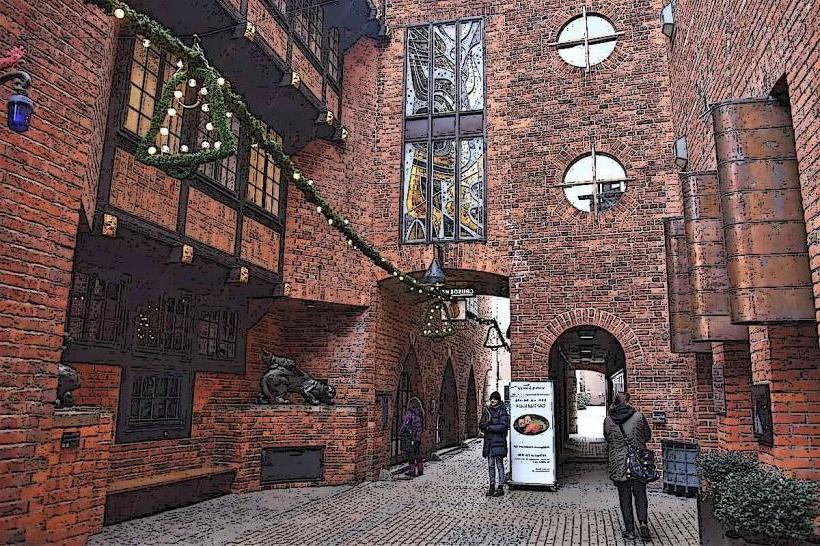
Böttcherstraße – 0.1km South
Schütting (Chamber of Commerce) – Adjacent (South)
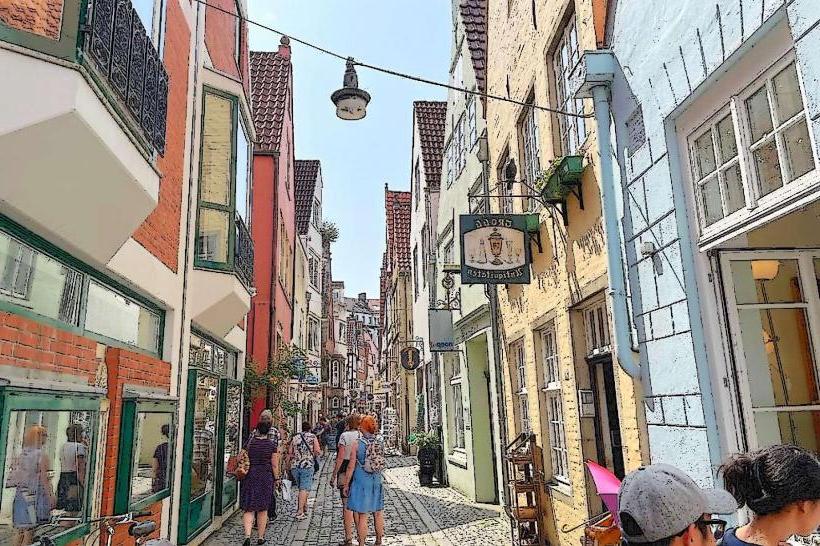
Schnoor Quarter – 0.3km Southeast