Landmark: Glyptothek
City: Munich
Country: Germany
Continent: Europe
Glyptothek, Munich, Germany, Europe
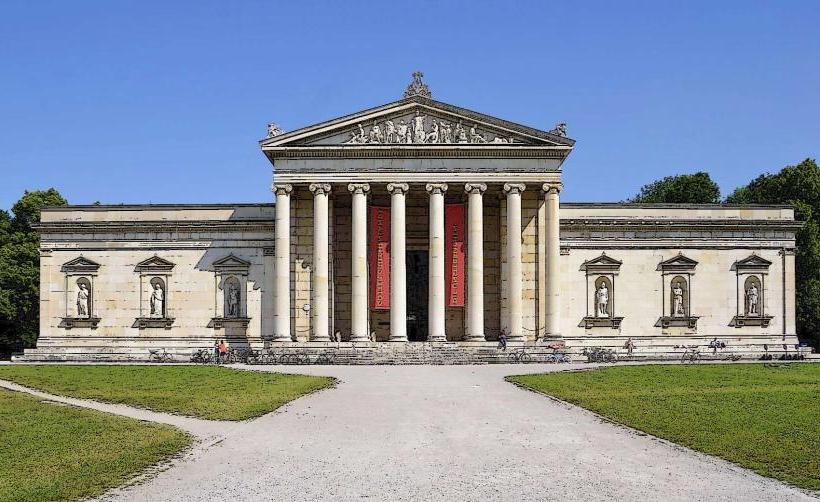
The Glyptothek is Munich’s oldest public museum and the only one in the world dedicated solely to ancient sculpture. It is located on the north side of the Königsplatz in the Kunstareal district.
Visual Characteristics
The building is a Neoclassical masterpiece designed as a Greek temple with Ionic columns and a central portico. The exterior walls feature niches containing 18 original statues of real and mythical artists. The interior consists of 14 vaulted halls arranged around a central courtyard. Unlike many modern museums, the Glyptothek uses natural light filtered through high windows to illuminate its marble contents, and the interior walls are made of exposed red brick, providing a high-contrast backdrop for the white sculptures.
Location & Access Logistics
The museum is located at Königsplatz 3, 80333 Munich. It is directly served by the U-Bahn station Königsplatz (line U2). It is also within walking distance (approx. 10 minutes) from the Hauptbahnhof (Main Station). There is no dedicated parking lot; limited paid street parking is available in the surrounding Maxvorstadt district.
Historical & Ecological Origin
Commissioned by Crown Prince (later King) Ludwig I of Bavaria to house his extensive collection of Greek and Roman sculptures, it was designed by architect Leo von Klenze and constructed between 1816 and 1830. The building was severely damaged by bombing in 1944. It was reconstructed between 1967 and 1972, during which the original colorful frescoes and stucco were not restored, resulting in the minimalist brick interior seen today.
Key Highlights & Activities
The Barberini Faun: A world-renowned Hellenistic sculpture of a sleeping satyr (c. 220 BC).
The Aegina Marbles: Pediment sculptures from the Temple of Aphaia, representing the transition from Archaic to Classical Greek art.
Medusa Rondanini: A high-classical Roman copy of a Greek bronze head.
Roman Portrait Busts: An extensive collection including Augustus, Nero, and Caligula.
Courtyard Cafe: The museum features a quiet interior courtyard with a cafe, considered one of the most tranquil spots in central Munich.
Infrastructure & Amenities
The museum includes a cloakroom, a specialized bookstore, and public restrooms. The entire ground floor exhibition area is wheelchair accessible. The facility is climate-controlled to preserve the marble artifacts. 5G cellular coverage is consistent throughout the Königsplatz area.
Best Time to Visit
The museum is closed on Mondays. Sunday admission is €1, making it the most cost-effective but also the busiest day. Thursday evenings are optimal for fewer crowds, as the museum remains open until 8:00 PM. Natural lighting for photography is best during mid-day when light is directly overhead.
Facts & Legends
A historical oddity is that Ludwig I purchased many of the collection's most famous pieces, such as the Aegina Marbles, by outbidding representatives from the British Museum and the Louvre. A local "secret" is the museum's acoustic properties; the vaulted brick halls create significant reverb, which is occasionally utilized for specialized evening concerts.
Nearby Landmarks
Staatliche Antikensammlungen – 0.1km South (Directly opposite)
Propyläen – 0.1km West
Lenbachhaus – 0.2km Northwest
Alte Pinakothek – 0.5km Northeast
Karolinenplatz – 0.4km East