Landmark: Olympic Park
City: Munich
Country: Germany
Continent: Europe
Olympic Park, Munich, Germany, Europe
Olympiapark is a 160-hectare multifunctional park complex in the Milbertshofen-Am Riesenfeld district of Munich. It was constructed for the 1972 Summer Olympics and remains a primary venue for sporting, cultural, and social events.
Visual Characteristics
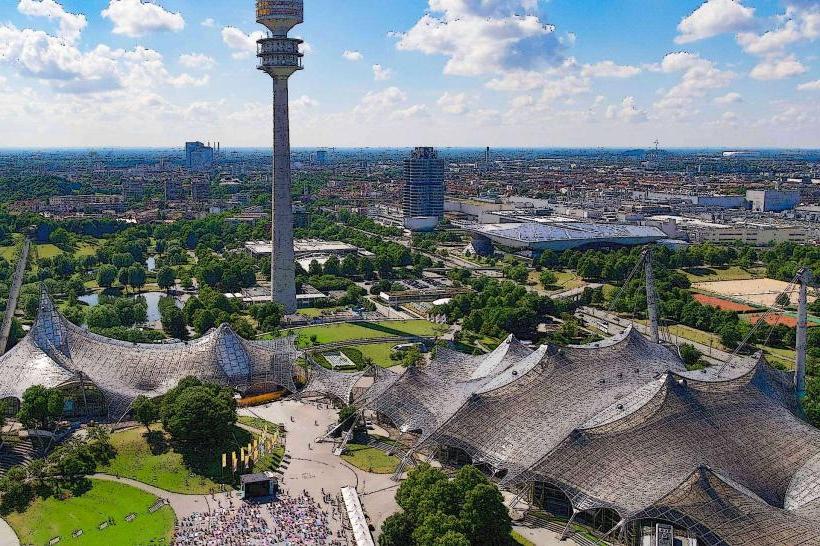
The park is defined by its revolutionary tent roof construction (Zeltdach), a series of sweeping, translucent glass-and-steel canopies that link the Olympic Stadium, Olympic Hall, and Olympic Swim Hall. The topography is hilly, featuring the 60-meter-high Olympiaberg (Olympic Hill), created from wartime rubble. A central 8.6-hectare artificial lake (Olympiasee) sits at the base of the venues, and the 291-meter Olympiaturm (Olympic Tower) dominates the skyline.
Location & Access Logistics
The site is located at Spiridon-Louis-Ring 21, 80809 Munich. It is primarily served by the U-Bahn line U3 at the Olympiazentrum station. Tram line 20 and 21 stop at Olympiapark West, and multiple bus lines (144, 173) serve the perimeter. Paid public parking is available at the "Parkharfe" lot near the stadium or the underground garage at BMW Welt.
Historical & Ecological Origin
The park was designed by the architectural firm Behnisch & Partner with landscape architect Günther Grzimek. Construction took place between 1968 and 1972 on the former "Oberwiesenfeld" airfield. The project aimed to create a "Green Olympics" with a democratic, non-monumental aesthetic, emphasizing organic forms and integration with the landscape. It is an ecological success, providing a significant urban habitat for diverse bird species and aquatic life in the lake.
Key Highlights & Activities
Visitors can ascend the Olympiaturm for a panoramic view of Munich and the Alps. The Olympic Stadium offers "Roof Climb" tours across the tent structure. The Olympiasee provides boat rentals and hosts the "Theatron" open-air concerts. Other attractions include Sea Life Munich, the Sokovic memorial to the 1972 victims, and the Olympic Walk of Stars.
Infrastructure & Amenities
The park features multiple permanent food outlets, including the revolving Restaurant 181 in the Olympic Tower and the Olympia-Alm beer garden on the hill. Public restrooms are located at the base of the tower and near the stadium entrances. The terrain is paved and mostly level, making the majority of the park wheelchair accessible, though the climb up Olympiaberg is steep. 5G signal is consistent throughout the open areas.
Best Time to Visit
Sunset is the optimal time for visiting Olympiaberg to view the city skyline. For architectural photography, early morning light highlights the transparency of the tent roofs. The park is most active during summer weekends and during major festivals like "Tollwood" (summer/winter) or "Sommernachtstraum" (fireworks display).
Facts & Legends
A historical oddity is the Ost-West-Friedenskirche (East-West Peace Church), a small shack built without a permit by a Russian hermit named Father Timofei using debris from the site; the city eventually adjusted the Olympic plans to allow the church to remain. A local "secret" is the stadium’s acoustics, which allow sound from concerts to be heard clearly for free from the top of the adjacent Olympic Hill.
Nearby Landmarks
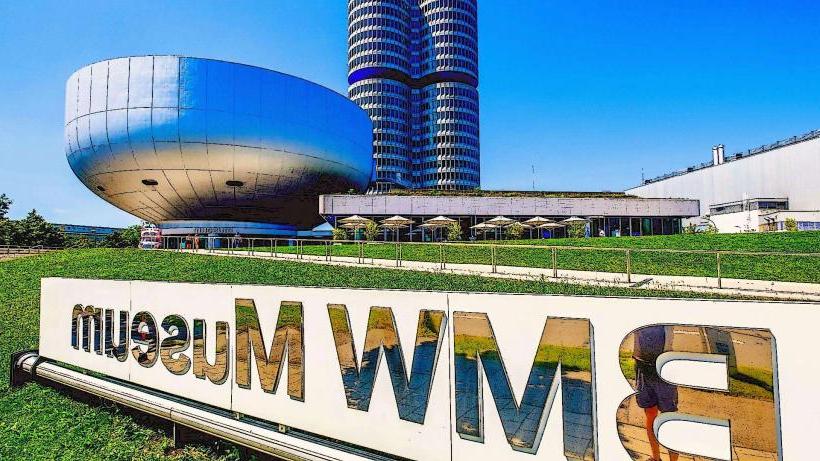
BMW Museum – 0.3km East
BMW Welt – 0.3km East
Sea Life Munich – 0.1km Central
Luitpoldpark – 1.1km East
Allianz Arena – 7.5km Northeast (Directly accessible via A9 or U6)