Landmark: Helen Hunt Falls
City: Colorado Springs
Country: USA Colorado
Continent: North America
Helen Hunt Falls, Colorado Springs, USA Colorado, North America
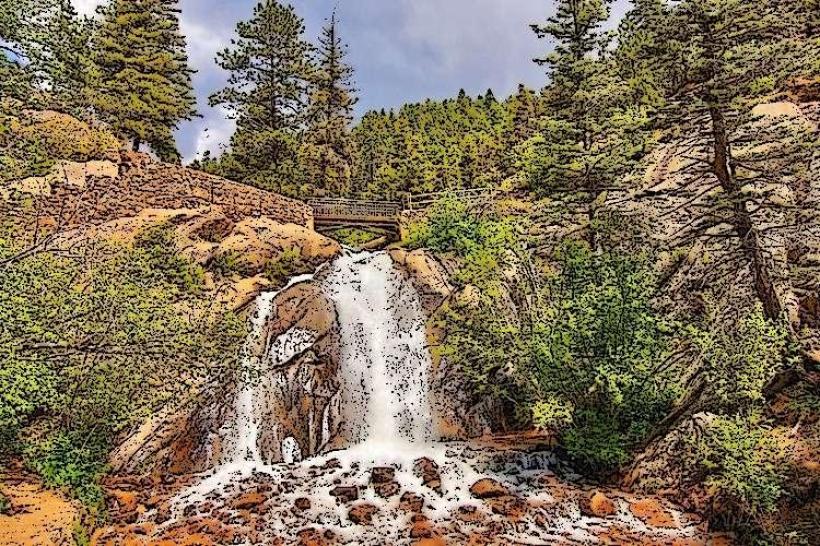
Helen Hunt Falls is a waterfall located in Colorado Springs, Colorado, USA. It is situated within the North Cheyenne Cañon Park.
Visual Characteristics
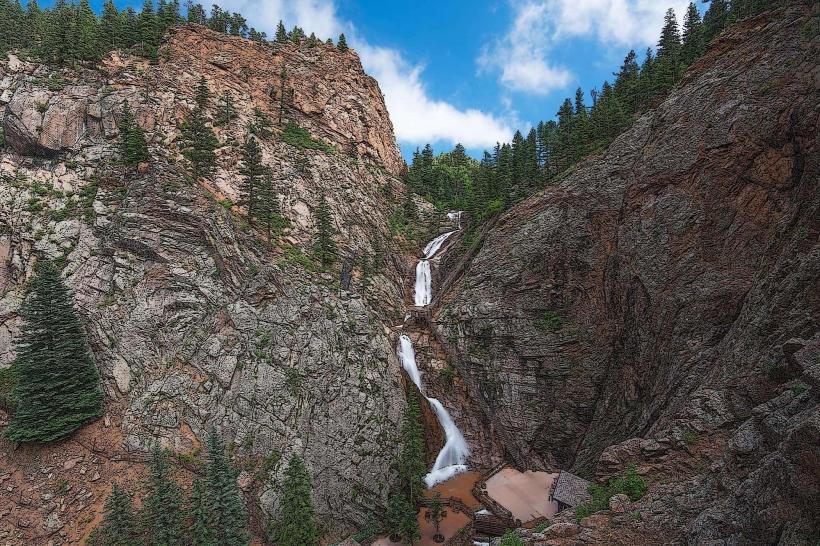
The falls descend approximately 30 feet over a granite rock face. The water flow varies seasonally, appearing as a thin cascade in dry periods and a more substantial flow after precipitation or snowmelt. The surrounding rock is primarily granite, with a moderate density of Ponderosa pine and Douglas fir trees on the slopes.
Location & Access Logistics
Helen Hunt Falls is located at the end of North Cheyenne Cañon Road. The park entrance is approximately 5 miles southwest of downtown Colorado Springs. Access is via North Cheyenne Cañon Road, which is paved. Parking is available in a designated lot adjacent to the falls. Public transport is not directly available to the falls; visitors typically use private vehicles.
Historical & Ecological Origin
The falls are a natural geological feature formed by erosion of the granite bedrock over millennia. The North Cheyenne Cañon area is part of the Front Range of the Rocky Mountains. The falls were named after Helen Hunt Jackson, an American writer and advocate for Native American rights, who lived in Colorado Springs.
Key Highlights & Activities
Observation of the waterfall is the primary activity. A paved path leads from the parking area to an overlook. Hiking trails are accessible from the vicinity, including the Columbine Trail. Photography is common, particularly during periods of higher water flow.
Infrastructure & Amenities
Restrooms are available at the parking area. Shade is provided by surrounding trees. Cell phone signal (4G/5G) is generally available. No food vendors are located directly at the falls; amenities are available in nearby residential areas or downtown Colorado Springs.
Best Time to Visit
For photography, early morning or late afternoon light offers optimal illumination on the falls. The best months for substantial water flow are typically April through June, following snowmelt. During drier summer months, the flow can be significantly reduced.
Facts & Legends
A specific historical oddity is that the falls were a popular destination for artists in the late 19th and early 20th centuries, who documented the landscape through paintings. A visitor tip is to check the local weather forecast for recent precipitation, as this directly impacts the visual impact of the waterfall.
Nearby Landmarks
- 0.8km Southwest: Columbine Trailhead
- 1.5km Southwest: Starsmore Discovery Center
- 3.0km Southwest: Mount Cutler Trailhead
- 4.5km Northwest: Broadmoor Seven Falls (requires separate admission)