Landmark: Mole National Park
City: Damongo
Country: Ghana
Continent: Africa
Mole National Park, Damongo, Ghana, Africa
Mole National Park is Ghana’s largest wildlife refuge, encompassing 4,577 square kilometers of undulating savanna and riparian ecosystem in the Savannah Region. It is located approximately 146km west of Tamale and serves as the primary sanctuary for the country's elephant and primate populations.
Visual Characteristics
The landscape is characterized by open Guinea savanna woodland with a high density of baobab (Adansonia) and shea (Vitellaria paradoxa) trees. During the dry season, the terrain features scorched ochre-colored earth and brittle, golden grasses, while the rainy season transforms the park into a dense green expanse. The park is situated on the Konkori Escarpment, offering vertical sandstone cliffs and two perennial watering holes visible from the main lodge area.
Location & Access Logistics
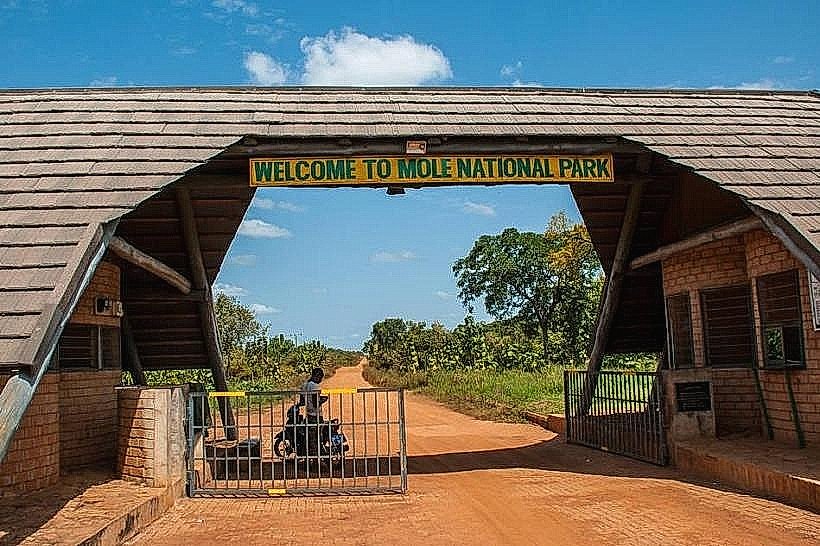
The park entrance is located 12km north of the town of Damongo. Access from Tamale is via the paved Fufulso-Sawla road (N12), a journey of approximately 2 to 2.5 hours. Public transport options include the daily Metro Mass Transit bus from Tamale to the park headquarters or private "tro-tros" to Damongo followed by a taxi. A paved parking lot is provided for private vehicles at the Mole Motel and Zaina Lodge entrance.
Historical & Ecological Origin
Mole was designated as a game reserve in 1958 and formally gazetted as a National Park in 1971. Geologically, it sits on the Voltain base, consisting of sedimentary rocks and sandstone outcrops. The park protects the headwaters of the Mole and Lovi Rivers and acts as a critical corridor for migratory West African wildlife.
Key Highlights & Activities
Foot safaris are conducted twice daily at 06:30 and 15:30, led by armed rangers. Jeep safaris utilize 4x4 vehicles to reach the more remote northern sectors. Observation of the resident African bush elephant population at the watering holes is the primary draw. Bird watching is a major activity, with over 300 species recorded, including the martial eagle and saddle-billed stork.
Infrastructure & Amenities
The park headquarters includes a visitor center, museum, and restrooms. On-site lodging ranges from the budget-friendly Mole Motel to the luxury Zaina Lodge, both offering shaded viewing decks and swimming pools. Cellular signal (4G) is strong near the headquarters but drops significantly once inside the deeper forest and savanna zones. Food is available through the motel restaurant and local vendors at the park gate.
Best Time to Visit
The optimal period for wildlife viewing is the peak dry season from December to April, when animals congregate around the remaining permanent water sources. Photography is best during the "Golden Hour" (06:30–07:30) to capture elephants in the mist. Visibility decreases during the rainy season (June to October) as vegetation becomes dense and animals disperse.
Facts & Legends
Mole is one of the few places in Africa where visitors can safely approach wild elephants on foot during a guided walking safari. A specific "secret" tip is that the elephants frequently enter the Mole Motel grounds at night to graze on the lawn and trees near the guest rooms, providing close-proximity viewing without a vehicle.
Nearby Landmarks
Mole Park Museum: 0.1km North
Lovi Camp: 31km North (Outside 5km radius, primary internal site)
Damongo Town Center: 12km South
Larabanga Mosque: 6.5km West
Mognori Eco-Village: 15km East