Landmark: Trier Cathedral
City: Trier
Country: Germany
Continent: Europe
Trier Cathedral, Trier, Germany, Europe
Trier Cathedral (Hohe Domkirche St. Peter zu Trier) is the oldest cathedral in Germany and the mother church of the Diocese of Trier. It is a UNESCO World Heritage site.
Visual Characteristics
The edifice is a complex layering of Roman, Romanesque, Gothic, and Baroque architecture. The exterior is dominated by massive Romanesque westwork with four towers and a facade of local limestone and brick. The interior features high-vaulted ceilings, a mix of white plaster and exposed stone, and an ornate Baroque altar.
Location & Access Logistics
Located at Liebfrauenstraße 12, 54290 Trier.
Transit: 10-minute walk from Trier Hauptbahnhof. Central pedestrian zone.
Access: Generally free entry; donations encouraged. Access restricted during liturgical services.
Hours: Daily 6:30 AM – 6:00 PM (Winter); until 7:00 PM (Summer).
Parking: Use "Parkhaus Basilika" or "Parkhaus Hauptmarkt."
Historical Origin
The cathedral stands on the site of a 4th-century Roman palace complex belonging to Empress Helena, mother of Constantine the Great. Construction began around 340 AD, making it the oldest church in the country. The core of the Roman building is still visible in the central section. It was expanded in the 11th and 12th centuries into the Romanesque structure seen today.
Key Highlights & Activities
The Holy Robe (Heiliger Rock): The cathedral's most famous relic, said to be the seamless garment worn by Jesus. It is kept in a sealed shrine and only rarely exhibited.
Cathedral Treasury (Domschatz): Houses one of the most important collections of Christian art, including the Andreas-Tragaltar (St. Andrew's portable altar), a masterpiece of 10th-century Ottonian goldsmithing.
The Cloister: A Gothic courtyard connecting the Cathedral to the Church of Our Lady (Liebfrauenkirche), offering a view of the architectural transitions.
Roman Masonry: Visible Roman brickwork in the central square section of the nave.
Infrastructure & Amenities
The main floor is wheelchair accessible via ramps. Photography is permitted without flash, except during services. A small shop is located within the cloister area. 5G signal is stable in the surrounding square.
Best Time to Visit
Noon: To hear the bells and experience the light through the high clerestory windows.
Organ Recitals: Regularly scheduled performances utilize the cathedral's massive "swallow's nest" organ.
Facts & Legends
A technical oddity is the Domstein, a massive 4-meter-long granite pillar lying near the main entrance. It is a remnant of the original Roman cathedral that collapsed during the 5th century. Legend claims the devil was tricked into helping build the cathedral and, upon realizing he was building a church, threw the pillar down in a rage, where it remains today.
Nearby Landmarks
Liebfrauenkirche (Church of Our Lady) – Directly adjacent (connected via cloister)
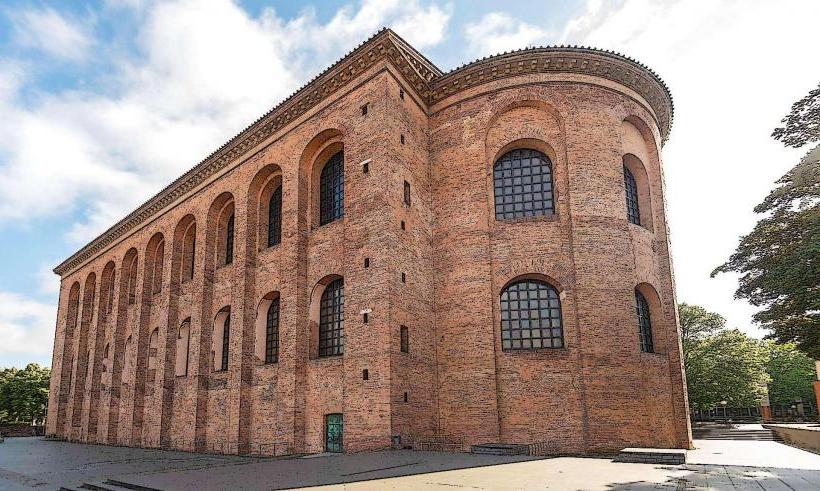
Basilica of Constantine – 0.3km South
Hauptmarkt (Main Market) – 0.2km West
Porta Nigra – 0.6km North