Landmark: Uros Floating Islands
City: Puno
Country: Peru
Continent: South America
Uros Floating Islands, Puno, Peru, South America
The Uros Floating Islands are a series of artificial islands constructed from totora reeds, located on Lake Titicaca near Puno, Peru.
These islands serve as the traditional home for the Uru people.
Visual Characteristics
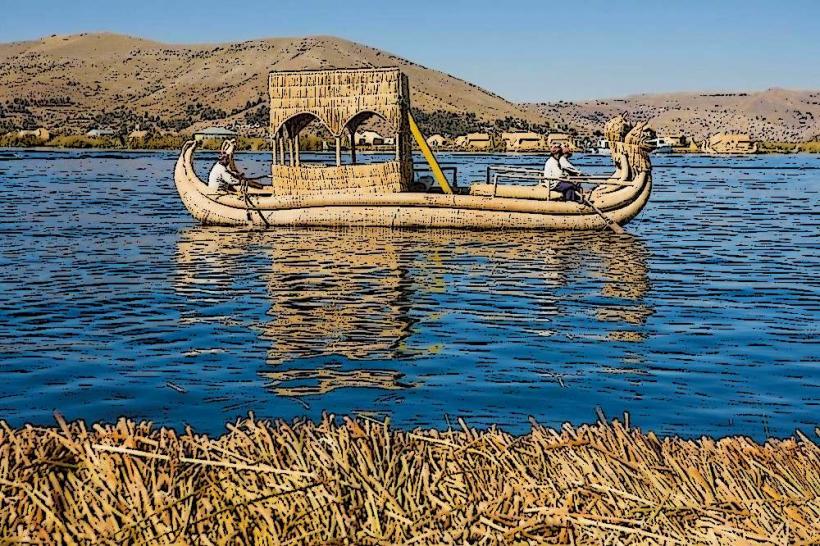
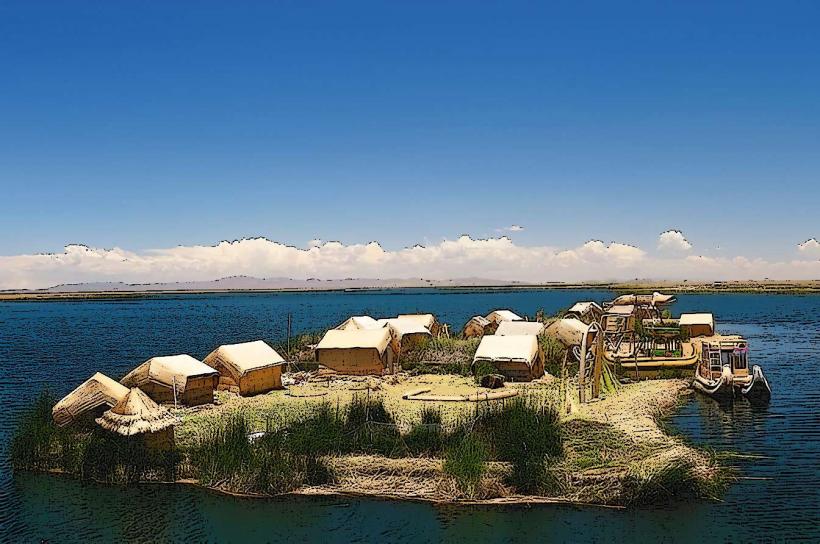
The islands are composed of dense layers of dried and fresh totora reeds, giving them a spongy, buoyant surface. The reeds are typically light brown to green, depending on their freshness. Structures on the islands, including homes and boats, are also constructed from totora reeds. The water of Lake Titicaca surrounding the islands is a deep blue.
Location & Access Logistics
The Uros Floating Islands are situated approximately 7 kilometers northwest of Puno's city center. Access is primarily via boat tours departing from the Puno port. Travel time by boat is approximately 30 minutes. Private boat hire is also available. There is no direct road access to the islands. Parking is available at the Puno port facilities.
Historical & Ecological Origin
The Uru people began constructing these floating islands centuries ago as a defensive strategy against potential invaders and to escape territorial disputes. The islands are built upon a foundation of thick totora reed roots and layers of dried reeds, which are continuously replenished. The totora reed (Schoenoplectus californicus) is a buoyant aquatic plant native to the region.
Key Highlights & Activities
Visitors can observe the construction techniques of the reed islands. Demonstrations of traditional Uru life, including weaving and fishing, are often presented. Boat rides on smaller reed boats are available. Interaction with residents to learn about their culture is a primary activity. Souvenir sales of handmade reed crafts occur on the islands.
Infrastructure & Amenities
Basic sanitation facilities (latrines) are present on some larger islands. Limited shade is provided by reed structures. Cell phone signal (4G) is generally available. Food vendors are not permanently stationed on the islands; tours may include stops at restaurants on larger islands or return to Puno for meals.
Best Time to Visit
The best time of day for photography is mid-morning to early afternoon when sunlight is strongest on the reeds and water. The dry season, from May to October, offers clearer skies and calmer lake conditions. Lake Titicaca's altitude means temperatures can be cool year-round; layers are recommended.
Facts & Legends
A unique aspect of the Uros culture is their diet, which historically relied heavily on the totora reed itself, consuming its roots and stalks. Legends speak of the Uru people as "the men of the water," who have always lived on the lake, distinct from the Aymara and Quechua peoples.
Nearby Landmarks
- Amantani Island (25km Southwest)
- Taquile Island (30km Southwest)
- Sillustani Burial Towers (20km Northeast)
- Puno Cathedral (7km Southeast)
- Lake Titicaca National Reserve (Variable distances)