Landmark: Monument to the Negev Brigade
City: Beersheba
Country: Israel
Continent: Asia
Monument to the Negev Brigade, Beersheba, Israel, Asia
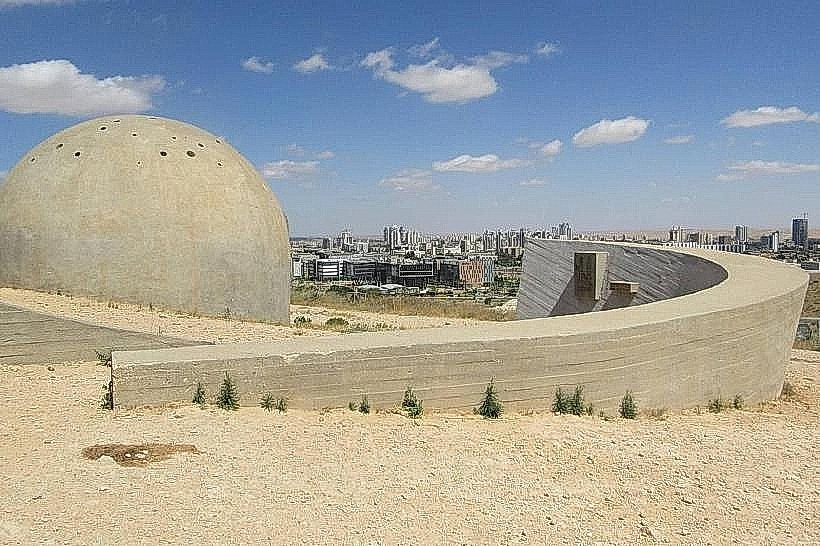
The Monument to the Negev Brigade (Andartat Hativat HaNegev) is a massive, symbolic brutalist sculpture situated on a hilltop overlooking the modern city of Beersheba. It commemorates the Palmach's Negev Brigade, which successfully defended the region during the 1948 Arab-Israeli War.
Visual Characteristics
Designed by the renowned artist Dani Karavan, the monument is a sprawling landscape of 18 distinct reinforced concrete elements. These abstract forms include a perforated tower resembling a watchtower, a geometric "water pipe" representing the struggle for resources, and a series of defensive walls. The raw, grey concrete textures contrast sharply with the yellow desert sands. Visitors can walk through, climb on, and enter the hollow structures, which use shadows and wind to create a sensory experience of the desert environment.
Location & Access Logistics
The monument is located on a ridge northeast of Beersheba, at the end of Hativat HaNegev Street. It is easily accessible by car, with a large, free parking lot at the base of the site. While there is no direct bus stop at the monument itself, local buses serve the nearby Ramot neighborhood, followed by a 15-minute uphill walk. For those hiking, the site is a prominent stop on several local trails connecting the city to the northern Negev hills.
Historical & Ecological Origin
Constructed between 1963 and 1968, the monument was built on "Hill 315," a strategic point that saw intense combat during the war. Geologically, the site sits on a flint and limestone ridge that offers natural drainage and stability for the heavy concrete forms. The design intentionally incorporates the harsh ecological conditions of the Negev-sunlight through the perforations creates "light poems" on the interior floors, and the narrow passages channel the desert wind to create a low whistling sound.
Key Highlights & Activities
The Watchtower is the site’s highest point, offering a panoramic view of the Beersheba skyline, the Hebron hills to the north, and the vast desert plains to the south. Visitors can explore the Memorial Room, where the names of the fallen soldiers are engraved in the concrete. The open nature of the site makes it a popular location for photography, particularly for those interested in mid-century architecture and the play of light on geometric shapes.
Infrastructure & Amenities
The monument is an open-air site with no entrance fee. There are no permanent restrooms or visitor centers directly on the hill, though these are available at the nearby university and hospital complexes a short drive away. The site is only partially ADA-compliant; while the base of the monument is accessible, many of the interior segments involve narrow stairs, steep ramps, and uneven concrete surfaces. Full 5G cellular coverage is available.
Best Time to Visit
The monument is open 24 hours a day. The absolute best time for a visit is sunset, when the concrete structures catch the orange glow of the desert sun and the city lights below begin to flicker on. Early morning is also recommended to avoid the intense heat, as there is very little shade on the hill. It is a particularly evocative site during the annual Independence Day and Memorial Day ceremonies.
Facts & Legends
A historical oddity is that the monument was one of the first in Israel to use abstract, non-figurative art to commemorate war, a controversial move at the time that eventually became a hallmark of Israeli architectural style. Local legend states that the "water pipe" structure is so acoustically precise that if you whisper at one end, you can be heard clearly at the other, symbolizing the vital communication lines during the 1948 siege.
Nearby Landmarks
Ben-Gurion University of the Negev – 2.0km West
Tel Beer Sheva National Park – 4.0km Southeast
Beersheba River Park – 4.5km South
Soroka Medical Center – 2.5km West
Joe Alon Center for Bedouin Culture – 20km North