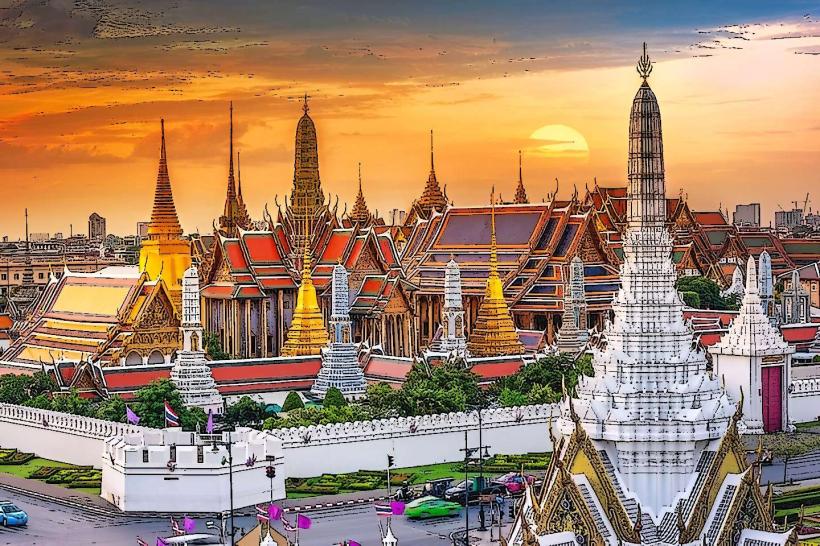
Landmark: Grand Palace
City: Bangkok
Country: Thailand
Continent: Asia
Grand Palace, Bangkok, Thailand, Asia
The Grand Palace is a complex of buildings in Bangkok, Thailand, serving as the official residence of the Kings of Siam (and later Thailand).
It is situated on the east bank of the Chao Phraya River.
Visual Characteristics
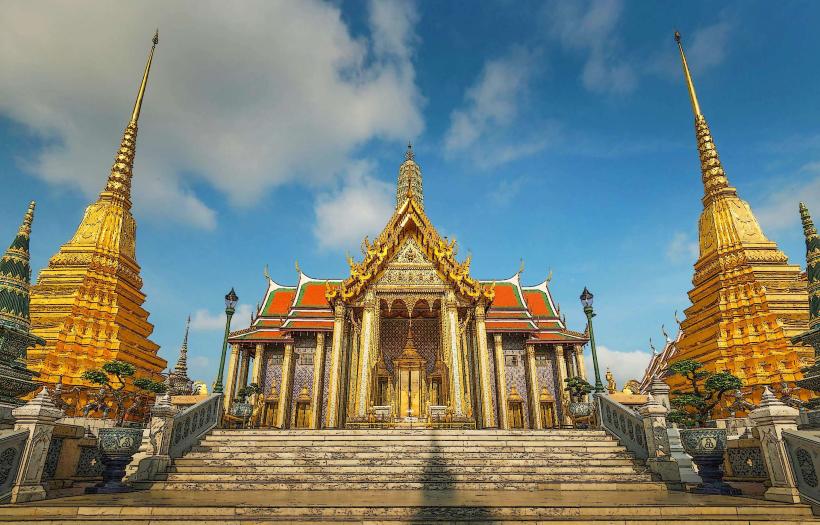
The complex features a blend of Thai and European architectural styles. Structures are predominantly constructed from concrete and plaster, often adorned with gilded stucco and mirrored mosaics. Roofs are multi-tiered and steeply pitched, characteristic of traditional Thai design. Key buildings include the Chakri Maha Prasat Hall, which combines Thai roofing with a European Renaissance-style facade, and the Dusit Maha Prasat Hall, an example of classic Rattanakosin architecture. The Wat Phra Kaew (Temple of the Emerald Buddha) within the complex houses a highly revered Buddha image.
Location & Access Logistics
The Grand Palace is located at Na Phra Lan Road, Phra Borom Maha Ratchawang, Phra Nakhon, Bangkok 10200. It is approximately 2 kilometers west of the city center. Access is primarily via the Chao Phraya River, with the Tha Chang Wang Luang pier (N9) being the closest. From this pier, it is a 5-minute walk. Public bus routes serving the area include 1, 3, 9, 15, 25, 32, 33, 44, 47, 53, 59, 64, 82, 123, 128, 157, 169, 171, 183, 201, 203, 503, 508, 512, and 524. Taxis and ride-sharing services are also available, though traffic can be significant. Parking is limited and generally not recommended for visitors.
Historical & Ecological Origin
Construction of the Grand Palace began in 1782 under King Rama I, the founder of the Chakri Dynasty. It was built to serve as the royal residence and the seat of government. The complex has been expanded and modified by successive monarchs. The site itself is a low-lying alluvial plain characteristic of the Chao Phraya River basin.
Key Highlights & Activities
Visitors can explore the various royal residences, audience halls, and temples within the complex. Specific areas include the Chakri Maha Prasat Hall, the Dusit Maha Prasat Hall, and the Temple of the Emerald Buddha (Wat Phra Kaew). Photography is restricted inside certain buildings. Guided tours are available in multiple languages. The complex is best explored on foot.
Infrastructure & Amenities
Restrooms are available within the complex. Shaded areas are present in courtyards and within some buildings. Cell phone signal (4G/5G) is generally good throughout the grounds. Food vendors and restaurants are located outside the main palace complex, particularly near the Tha Chang Wang Luang pier.
Best Time to Visit
The best time of day for photography is generally in the morning, between 8:00 AM and 10:00 AM, when the light is softer and crowds are smaller. The dry season, from November to February, offers the most pleasant weather with lower humidity and cooler temperatures. The Grand Palace is open daily from 8:30 AM to 3:30 PM, with last entry at 3:30 PM.
Facts & Legends
The Emerald Buddha, housed in Wat Phra Kaew, is carved from a single block of jade and is considered the most sacred object in Thailand. Its origins are debated, with some legends placing its creation in India or Sri Lanka. The Buddha image is ritually changed by the King of Thailand three times a year to correspond with the changing seasons.
Nearby Landmarks
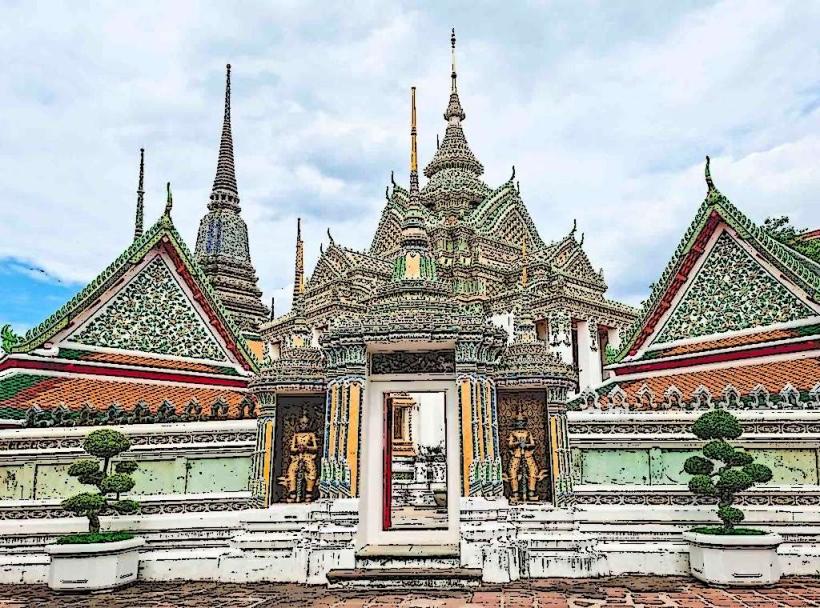
- Wat Pho (Temple of the Reclining Buddha) - 0.3km Southwest
- Museum Siam - 0.6km West
- Amulet Market - 0.2km Northwest
- Chao Phraya River - 0.2km East
- Pak Khlong Talat (Flower Market) - 1.0km Southwest