Landmark: Playa La Coloma
City: Isla de la Juventud
Country: Cuba
Continent: North America
Playa La Coloma, Isla de la Juventud, Cuba, North America
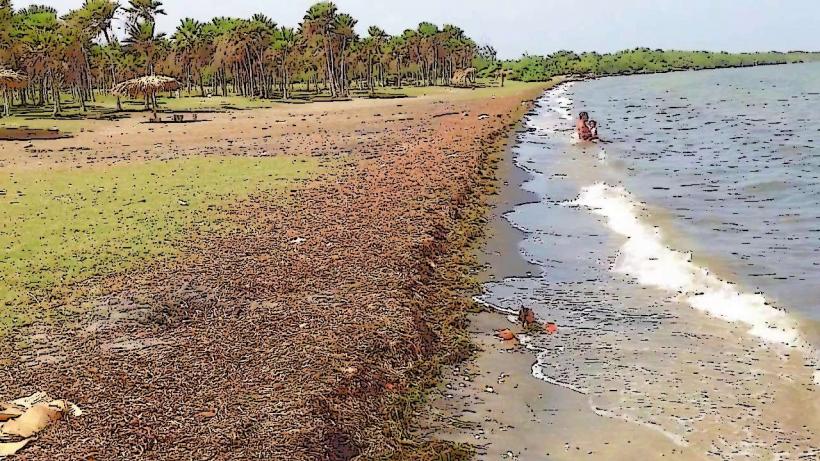
Playa La Coloma is a coastal area situated on the southern side of Isla de la Juventud, Cuba.
This location comprises a beach and adjacent mangrove ecosystems.
Visual Characteristics
The beach consists of dark, fine-grained sand. The water clarity varies, often appearing murky due to sediment runoff from the nearby mangroves. The shoreline is characterized by a dense growth of red mangrove (Rhizophora mangle) trees, forming a thick, green barrier.
Location & Access Logistics
Playa La Coloma is located approximately 35 kilometers south of Nueva Gerona, the main city on Isla de la Juventud. Access is via the Carretera de la Coloma, a paved road. The final 2 kilometers are unpaved and can be challenging for standard vehicles, especially during the rainy season. Parking is informal and available along the roadside near the beach access point. Public transport to this specific location is limited; local buses operate between Nueva Gerona and smaller settlements, but a transfer or taxi would likely be required for the final segment.
Historical & Ecological Origin
The ecological origin of Playa La Coloma is primarily a mangrove estuary system, a critical habitat for numerous marine and terrestrial species. Historically, the area has been utilized by local communities for fishing and as a point of access to the sea. There is no record of significant construction or specific architectural development at this site.
Key Highlights & Activities
Observation of mangrove ecosystems is a primary activity. Birdwatching is possible, with species common to Cuban coastal wetlands present. Fishing from the shore or by small boat is undertaken by local residents. Swimming is possible but not recommended due to water clarity and potential marine life.
Infrastructure & Amenities
There are no formal public restrooms or shade structures at Playa La Coloma. Food vendors are not present at the immediate beach site; provisions would need to be brought from Nueva Gerona. Cell phone signal (3G/4G) is generally weak to non-existent at this remote location.
Best Time to Visit
The best time for birdwatching is during the early morning or late afternoon. The dry season, from November to April, offers more stable road conditions. High tide can increase the proximity of the mangrove line to the water's edge.
Facts & Legends
Local fishermen report occasional sightings of manatees (Trichechus manatus) in the deeper channels adjacent to the mangroves, though these are rare and elusive.
Nearby Landmarks
- Cayo Rosario (15km Southwest)
- Punta del Este (20km West)
- Presidio Modelo (30km North)
- Museo de la Piratería (32km North)
- Nueva Gerona (35km North)