Landmark: Pont Neuf
City: Toulouse
Country: France
Continent: Europe
Pont Neuf, Toulouse, France, Europe
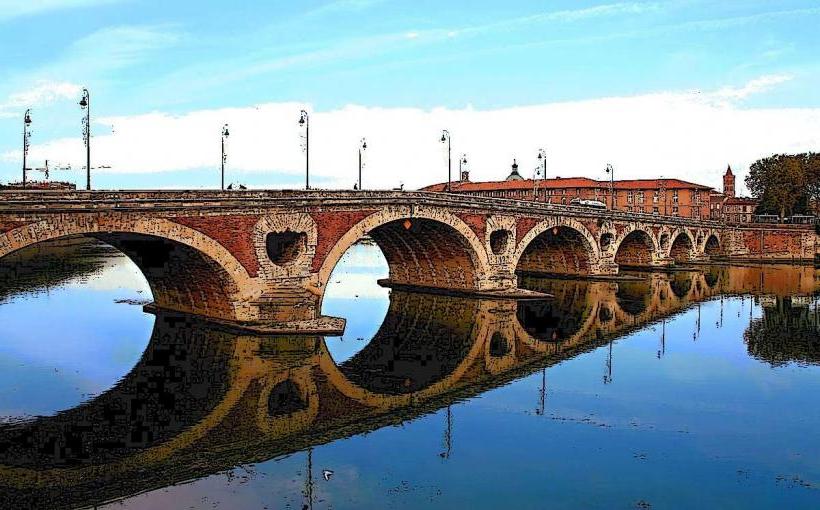
The Pont Neuf is the oldest standing bridge over the Garonne River in Toulouse, France. Despite its name meaning "New Bridge," it was constructed between 1544 and 1632 to replace older wooden structures that were frequently destroyed by floods.
Visual Characteristics
The bridge is a 220-meter masonry structure featuring seven irregular arches. Its primary material is the local red "foraine" brick, reinforced with white limestone for the piers and arches. A distinctive architectural feature is the presence of circular openings (oculi) in the piers, designed to reduce the structure’s resistance to water flow during extreme flooding events.
Location & Access Logistics
The bridge connects the Place Esquirol (Right Bank) to the Cours Dillon and the Saint-Cyprien district (Left Bank). It is accessible via the Toulouse Metro Line A at the "Esquirol" or "Saint-Cyprien – République" stations. The bridge is open to vehicles, cyclists, and pedestrians, featuring wide sidewalks for viewing the river.
Historical & Ecological Origin
Construction was authorized by Francis I and involved several architects, including Nicolas Bachelier. The bridge’s completion took nearly 90 years due to the technical challenges posed by the Garonne's powerful and unpredictable currents. Geologically, the foundations were built using a technique of driving oak piles into the river’s clay bed. It is the only bridge in Toulouse to have survived every major flood of the Garonne, including the catastrophic flood of 1875.
Key Highlights & Activities
Panorama: The bridge offers a 360-degree view of the Garonne, the Hôtel-Dieu Saint-Jacques, and the Dôme de la Grave.
Photography: It is the primary location for capturing the "Ville Rose" skyline at sunset.
River Access: The stairs at the ends of the bridge lead down to the Quai de la Daurade, a popular park for picnics and social gatherings.
Infrastructure & Amenities
The bridge is a public thoroughfare with no specific amenities on the span itself. However, the Quai de la Daurade on the right bank provides public benches, green space, and nearby cafes. High-speed 5G cellular coverage is consistent across the entire structure. The sidewalks are wide and accessible to individuals with reduced mobility.
Best Time to Visit
Optimal viewing occurs during the "golden hour" before sunset when the red brick glows intensely. At night, the bridge is illuminated by floodlights, highlighting the architectural oculi and reflections in the Garonne.
Facts & Legends
A historical oddity is the "Triumphal Arch" that once stood at the entrance of the bridge on the right bank, which was demolished in the 19th century to facilitate traffic. A persistent engineering fact is that the bridge is asymmetrical; the arches are of different sizes and are not perfectly aligned with the river's axis, a design intended to better withstand the force of the water.
Nearby Landmarks
Hôtel-Dieu Saint-Jacques – Adjacent (Southwest bank)
Basilique de la Daurade – 0.2km North
Place Esquirol – 0.3km East
Musée des Augustins – 0.5km East
Château d'Eau (Photography Gallery) – 0.2km West