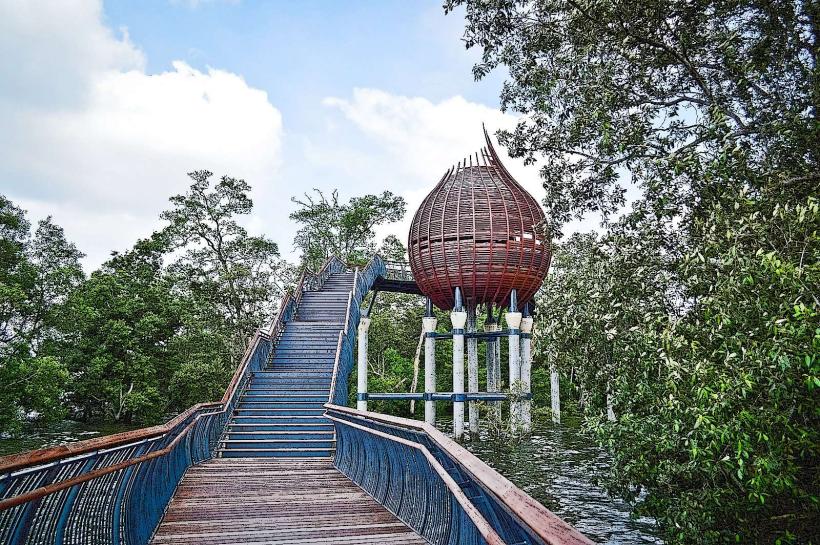
Landmark: Sungei Buloh Wetland Reserve
City: Western Region
Country: Singapore
Continent: Asia
Sungei Buloh Wetland Reserve, Western Region, Singapore, Asia
Sungei Buloh Wetland Reserve is a protected nature area located in the northwestern part of Singapore. It functions as a critical stopover point for migratory birds along the East Asian-Australasian Flyway.
Visual Characteristics
The reserve comprises mangrove forests, mudflats, and brackish water ponds. Dominant vegetation includes Rhizophora and Avicennia species. The mudflats are exposed during low tide, revealing a substrate rich in benthic organisms. Several observation towers and boardwalks are constructed from treated timber and metal, providing elevated vantage points over the wetlands.
Location & Access Logistics
Sungei Buloh Wetland Reserve is situated at 301 Neo Tiew Crescent, Singapore 718925. It is approximately 25 kilometers from the Singapore city center. Access by private vehicle is via Kranji Expressway (KJE) and then Lim Chu Kang Road, followed by Neo Tiew Road and Neo Tiew Crescent. Parking is available at the main visitor center. Public transport options include SBS Bus Service 925 from Kranji MRT station, which operates on weekdays, Saturdays, and Sundays. On Sundays and public holidays, it extends its service to the reserve entrance.
Historical & Ecological Origin
The area was designated as a nature park in 1993 and officially gazetted as a wetland reserve in 2002. Its ecological significance lies in its role as a vital feeding and resting ground for migratory birds. The mangrove ecosystem is a natural buffer against coastal erosion and provides habitat for diverse flora and fauna, including mudskippers, fiddler crabs, and monitor lizards.
Key Highlights & Activities
Observation of migratory birds, particularly during the September to March season. Walking the boardwalks and nature trails, including the Mid-Canopy Walkway and the Elevated Boardwalk. Visiting the observation hides for birdwatching. Exploring the Dragonfly Pond and the Mangrove Boardwalk. Photography of wildlife and flora.
Infrastructure & Amenities
Restrooms are available at the main visitor center and at designated points within the reserve. Shaded areas are provided by boardwalk shelters and observation towers. Cell phone signal (4G/5G) is generally available throughout the reserve. Food and beverage options are limited to vending machines at the visitor center; the nearest external food vendors are located outside the reserve.
Best Time to Visit
For birdwatching, the migratory season from September to March offers the highest diversity and numbers of birds. Early morning (07:00-10:00) and late afternoon (16:00-18:00) provide optimal lighting conditions for photography and increased wildlife activity. Low tide periods are best for observing mudflat inhabitants.
Facts & Legends
The reserve is home to a resident population of estuarine crocodiles, which are occasionally sighted. A specific tip for visitors is to wear insect repellent, especially during dawn and dusk, due to the presence of mosquitoes.
Nearby Landmarks
- Kranji Reservoir Park (1.5km Northeast)
- Bollywood Veggies (2.0km West)
- Hay Dairies Goat Farm (2.5km Northwest)
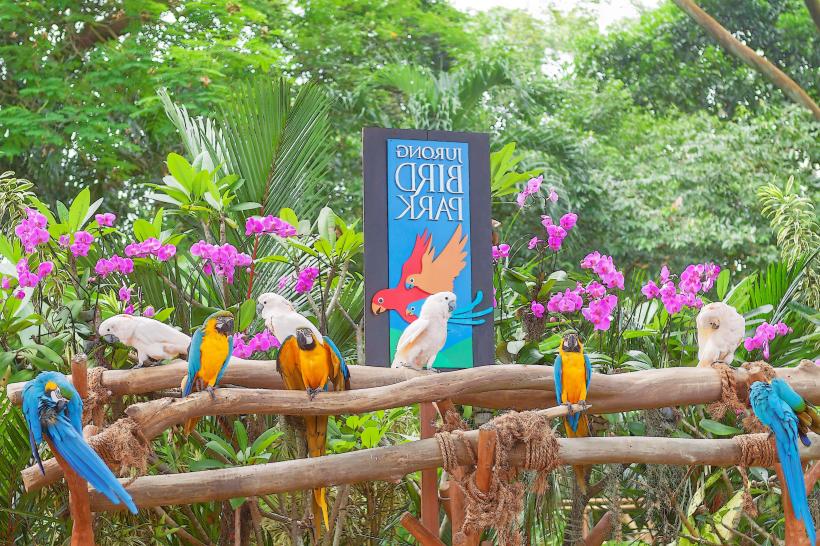
- Jurong Bird Park (now Bird Paradise) (10km Southeast - outside 5km radius, but significant nearby attraction)