Landmark: Ateshgah Caravanserai (Fire Temple)
City: Baku
Country: Azerbaijan
Continent: Asia
Ateshgah Caravanserai (Fire Temple), Baku, Azerbaijan, Asia
The Ateshgah Caravanserai, also known as the Fire Temple, is a historical religious site located on the Absheron Peninsula, approximately 30 kilometers east of Baku, Azerbaijan.
Visual Characteristics
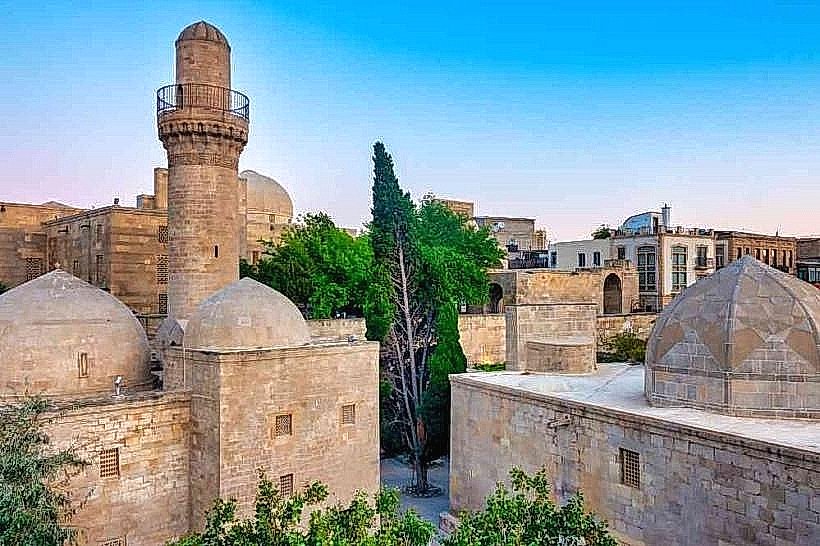
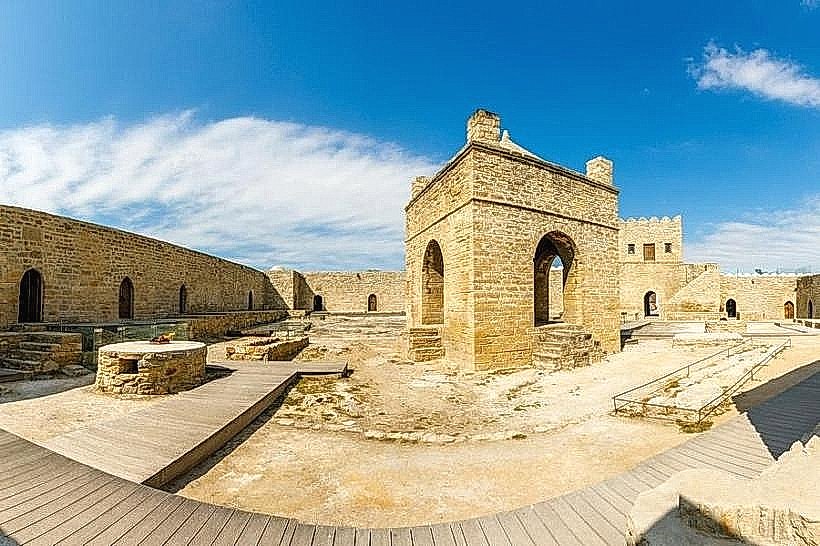
The structure is a pentagonal complex constructed primarily from local limestone. It features a central courtyard surrounded by a two-story arcade of cells, which served as living quarters and storage for pilgrims and merchants. The main entrance is marked by a large, arched portal. The temple's architecture exhibits influences from Indian and local Azerbaijani styles, with decorative elements such as carved friezes and geometric patterns. A prominent octagonal tower, believed to be a shrine, stands at the center of the courtyard.
Location & Access Logistics
The Ateshgah is situated 30 kilometers east of Baku's city center. Access is via the M4 highway towards the airport, then following signs for Surakhani. The site has a dedicated parking area. Public transport options include bus route 149 from Koroglu Metro Station, which stops near the entrance.
Historical & Ecological Origin
The current structure dates primarily from the 18th century, built by the Zoroastrian community of Baku. However, the site's origins as a place of worship for fire worshippers date back much earlier, possibly to the Sasanian period (3rd-7th centuries CE). The natural gas seeping from the ground fueled the eternal flames that made this location sacred.
Key Highlights & Activities
Visitors can explore the cells that once housed pilgrims, examine the inscriptions in various languages, and observe the preserved fire pits. The central altar area is a focal point. Informational displays within the complex detail the history of Zoroastrianism and the site's significance. Photography of the architectural features and the central altar is permitted.
Infrastructure & Amenities
Restrooms are available on-site. Limited shaded areas are present within the arcade. Cell phone signal (4G) is generally reliable. Food vendors are not present directly at the site, but options exist in the nearby town of Surakhani.
Best Time to Visit
The best time for photography is during the morning or late afternoon when the sunlight creates distinct shadows on the stone. The months of April to June and September to October offer the most pleasant weather, with average temperatures ranging from 15-25 degrees Celsius. Visiting during daylight hours is recommended.
Facts & Legends
The Ateshgah was a pilgrimage site for Zoroastrians, Hindus (particularly from India), and Sikhs. One legend suggests that the flames were inextinguishable and burned continuously for centuries, fueled by underground natural gas. The site was abandoned in the late 19th century due to the depletion of the natural gas supply.
Nearby Landmarks
- 0.8km West: Surakhani Oil Fields (historical industrial area)
- 3.5km Northwest: Heydar Aliyev International Airport (modern infrastructure)
- 4.2km Southwest: Bibi-Heybat Mosque (reconstructed religious site)
- 4.8km West: National Aviation Academy (educational institution)