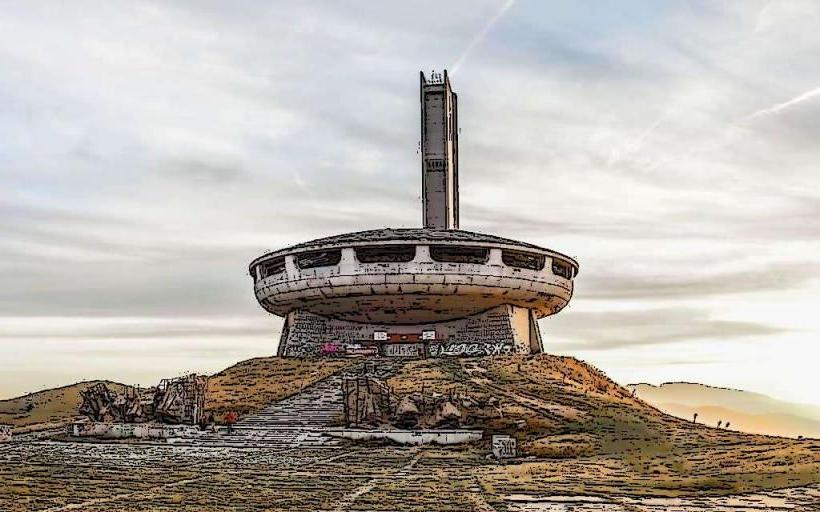
Landmark: Buzludzha Monument
City: Stara Zagora
Country: Bulgaria
Continent: Europe
Buzludzha Monument, Stara Zagora, Bulgaria, Europe
The Buzludzha Monument, officially known as the House-Monument of the Bulgarian Communist Party, is a massive abandoned brutalist structure located on the Buzludzha Peak (1,432m) in the Central Balkan Mountains. It was built to commemorate the secret assembly of 1891 that led to the formation of the Bulgarian Social Democratic Party.
Visual Characteristics
The monument is shaped like a concrete flying saucer (discoid) with a diameter of 60 meters and a height of 15 meters, accompanied by a 70-meter-tall vertical pylon featuring two 12-meter red glass stars. The exterior is made of reinforced concrete, now weathered and grey, while the interior was originally lined with over 510 square meters of intricate mosaics made of cobalt glass and natural stone. The roof, once covered in copper, is largely stripped, exposing the structural steel ribs.
Location & Access Logistics
The site is located 12km east of the Shipka Pass and roughly 40km north of Stara Zagora. Access is via a paved but deteriorating mountain road branching off the main I-5 highway (Shipka-Kazanlak). There is a large paved parking area at the base of the monument. No public transport reaches the peak; visitors must use private vehicles, taxis from Kazanlak, or hike the steep trails from the Shipka Pass or the Krustets railway station.
Historical & Ecological Origin
Commissioned by the Bulgarian Communist Party, the monument was designed by architect Georgi Stoilov and completed in 1981 after seven years of construction involving over 6,000 workers and soldiers. It sits on a karst limestone peak within the Central Balkan National Park, a region characterized by sub-alpine meadows and severe weather patterns, including high-velocity winds and heavy snow accumulation.
Key Highlights & Activities
Due to structural instability, the interior is currently closed to the public and guarded by a 24-hour police presence, though the exterior and the pylon are accessible for viewing. Visitors can walk the perimeter to observe the relief lettering at the entrance and the "Buzludzha Project" restoration efforts. The site serves as a major destination for architectural photography and offers panoramic views of the Rose Valley to the south and the Danubian Plain to the north.
Infrastructure & Amenities
Infrastructure at the peak is minimal; there are no public restrooms, running water, or food vendors. A few seasonal mountain huts (hizha) are located 2–3km downslope, offering basic lodging and meals. Cell phone signal (4G) is strong at the monument due to its elevation and the proximity of telecommunication towers on the pylon.
Best Time to Visit
The best months for road access are May through October. For photography, winter offers dramatic scenes with the structure frequently encased in "frozen" rime ice, though the road may be impassable without 4WD. The most effective lighting occurs at sunrise or during the "blue hour" when the silhouette of the saucer is most distinct against the horizon.
Facts & Legends
The red glass stars on the pylon were rumored to be made of genuine rubies, leading to several attempts by looters to shoot them out or climb the tower to retrieve fragments after the regime fell in 1989; they were actually made of industrial synthetic red glass from the Soviet Union. A local tip: even in mid-summer, temperatures at the peak are significantly lower than in Kazanlak, often accompanied by sudden fog or gale-force winds.
Nearby Landmarks
Shipka Memorial Church – 11.5km West
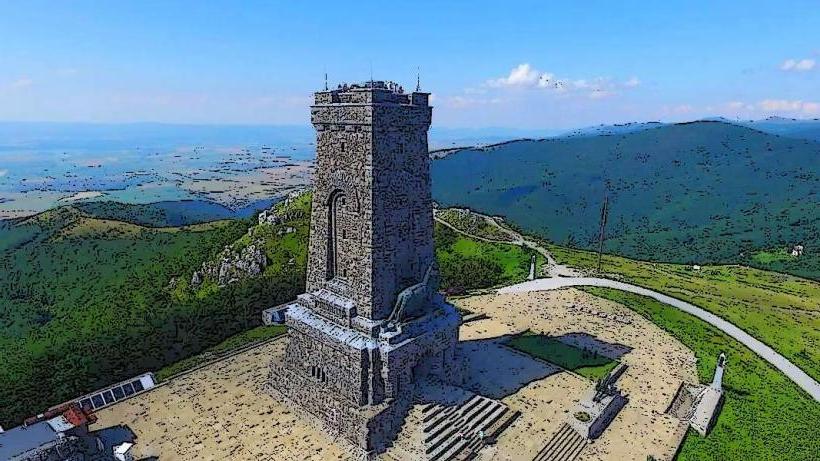
Shipka Monument (Freedom Monument) – 10.2km West
Tomb of Seuthes III (Kazanlak) – 15.5km South
The Valley of the Thracian Kings – 16.0km South
Buzludzha Hut – 2.1km Southwest