Landmark: Thracian Temple of Golyama Kosmatka
City: Stara Zagora
Country: Bulgaria
Continent: Europe
Thracian Temple of Golyama Kosmatka, Stara Zagora, Bulgaria, Europe
The Thracian Tomb of Golyama Kosmatka is a 5th-century BC royal heroon located within a massive burial mound 1 km south of Shipka and 12 km north of Kazanlak. It is one of the most elaborate and best-preserved monumental tombs in the Valley of the Thracian Kings, identified as the burial site of the Odrysian King Seuthes III.
Visual Characteristics
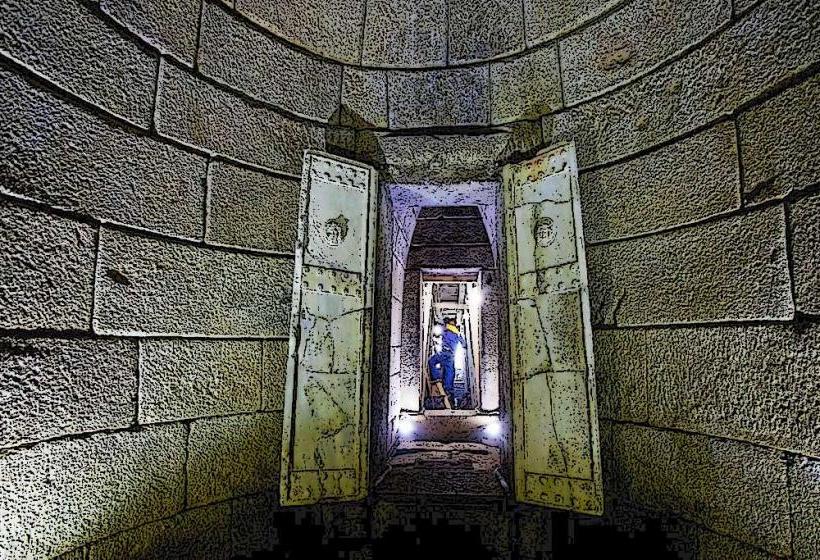
The tomb features a 13-meter-long dromos (corridor) lined with oak beams and stone walls, leading to three consecutive chambers. The first chamber is rectangular, the second is a circular tholos with a domed roof, and the third is a monolithic sarcophagus chamber carved from a single 60-ton granite block. The facade is constructed from massive hewn stone blocks and was originally sealed by a marble door with carved anthropomorphic images and ritual symbols.
Location & Access Logistics
The site is situated near the main Road 5 (E85) connecting Shipka and Kazanlak. From Stara Zagora, travel 45 km north via Road 5. A paved turn-off leads directly to a designated asphalt parking area at the base of the mound. Regional buses running between Kazanlak and Shipka stop at a nearby junction, from which the tomb is a 10-minute walk.
Historical & Ecological Origin
The tomb was built in the second half of the 5th century BC and served as a temple for Orphic rituals before becoming the burial place for Seuthes III at the end of the 4th century BC. It was discovered intact in 2004 by archaeologist Georgi Kitov. The mound is part of a cluster of tumuli in the Kazanlak Valley, a fertile tectonic basin between the Balkan Mountains and Sredna Gora.
Key Highlights & Activities
Visitors can enter the dromos and view the original granite sarcophagus chamber and the replica of the marble door. The site is famous for the discovery of the bronze head of Seuthes III and a gold laurel wreath (originals are in the Iskra Historical Museum in Kazanlak). On-site information boards explain the ritual "killing" of the bronze head and its burial in front of the tomb entrance.
Infrastructure & Amenities
The site includes a modern visitor reception building with a ticket office, a small museum shop, and public restrooms. The path to the entrance is paved and suitable for most visitors. 5G cellular signal is stable. The interior of the tomb is equipped with professional lighting and climate control systems. Food and refreshment options are available in the nearby town of Shipka.
Best Time to Visit
The tomb is open daily from 09:00 to 18:00 (summer) and 09:00 to 17:00 (winter). Photography is best in the morning when the sun illuminates the entrance portal. Because the primary interest is subterranean, it is a suitable location for visits during inclement weather.
Facts & Legends
Golyama Kosmatka remained unlooted for over two millennia because the entrance was deliberately buried and a horse was sacrificed in the corridor to "guard" the king. Upon discovery, archaeologists found an inscription on a gold phiale and a silver pitcher bearing the name "of Seuthes," providing definitive proof of the occupant's identity.
Nearby Landmarks
Tomb of Helvetia – 0.4km West
Shushmanets Tomb – 0.5km West
Shipka Memorial Church – 2.5km North
Kazanlak Thracian Tomb – 12km South
Ostrusha Mound – 1.5km South