Landmark: Fort Saint-Jean
City: Marseille
Country: France
Continent: Europe
Fort Saint-Jean, Marseille, France, Europe
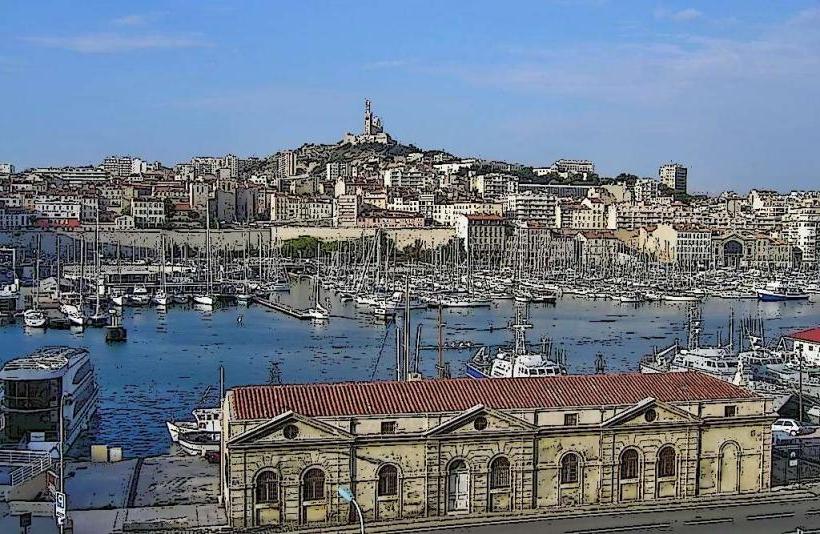
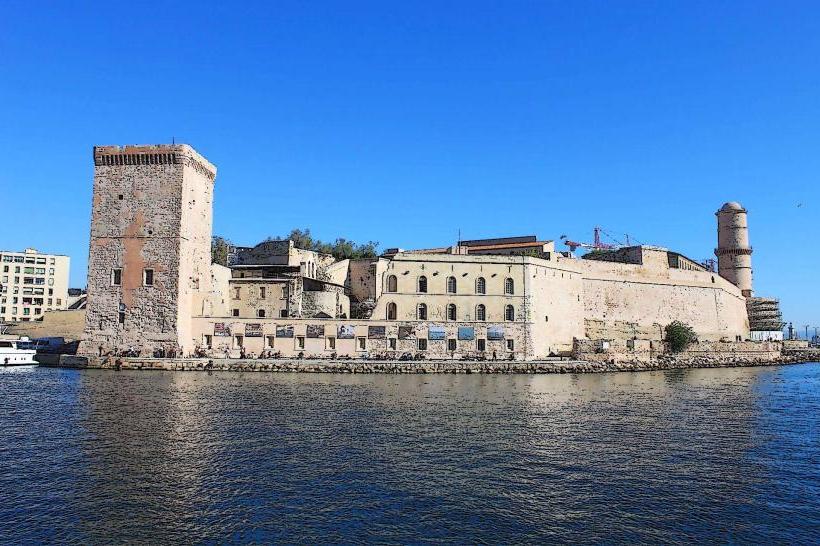
Fort Saint-Jean is a historic fortification in Marseille, situated at the northern entrance to the Vieux-Port (Old Port) in the 2nd arrondissement. It marks the site of the city's original Greek founding and now serves as a primary component of the Mucem (Museum of European and Mediterranean Civilisations).
Visual Characteristics
The fort is a complex of limestone bastions, barracks, and vaulted passages. Its most prominent features are the Tour du Roi René (a massive 15th-century square tower) and the Tour du Fanal (a 17th-century circular lighthouse tower). Unlike the aggressive military appearance of Fort Saint-Nicolas, Fort Saint-Jean is now integrated with modern architecture via a high-altitude, 115-meter footbridge that connects the fort's ramparts to the Mucem’s contemporary J4 building.
Location & Access Logistics
The main entrance is located on Promenade Robert Laffont. It is accessible via the Métro station Vieux-Port (Line 1) or Joliette (Line 2), and buses 82, 82S, and 60. Entry to the outdoor spaces, gardens, and ramparts is free to the public during museum hours. Access to the interior exhibition galleries requires a Mucem ticket. The fort is closed on Tuesdays.
Historical Origin
The site was occupied by the Hospitallers of Saint John of Jerusalem in the 12th century. The current fortification was commissioned by King Louis XIV in 1660 to reinforce the port's defenses and monitor the city’s population. During the French Revolution, it served as a prison for members of the Orleans family. In World War II, it was used by the German military as an ammunition depot, which resulted in a massive explosion during the 1944 liberation, destroying many of its internal buildings. It was fully restored and integrated into the Mucem in 2013.
Key Highlights & Activities
The Jardin des Migrations: A 12,000-square-meter Mediterranean garden featuring local flora and historical agricultural techniques.
The Ramparts: A public walkway offering panoramic views of the Mediterranean, the Pharo Palace, and the Frioul Islands.
Tour du Roi René: Houses exhibition spaces detailing the medieval history of the site.
Footbridges: Two major pedestrian bridges connect the fort to the Mucem J4 building and the Le Panier neighborhood.
Infrastructure & Amenities
The fort contains the Le Môle Passedat cafe and restaurant complex. Public restrooms are available. 5G/4G signals are strong. While the main paths and the Mucem bridge are wheelchair accessible, the historic ramparts include uneven cobblestones and steep grades that may be challenging.
Best Time to Visit
The fort is best visited in the late afternoon to observe the sunset over the Mediterranean. On Sundays, the gardens and walkways are a popular destination for local residents. The site is particularly tranquil during weekday mornings.
Facts & Legends
The Tour du Fanal (Beacon Tower) was built on the site of a 13th-century signaling tower used by sailors. A significant historical fact: the fort was the final headquarters for the French Foreign Legion before their departure for Algeria. Legend suggests that the "iron ring" once used to close the port with a giant chain was anchored at the base of this fort.
Nearby Landmarks
Mucem (J4 Building): 0.1km West
Cathedrale de la Major: 0.3km North
Le Panier (Old Town): 0.2km East
Vieux-Port: 0.1km South
Fort Saint-Nicolas: 0.3km South (across the water)