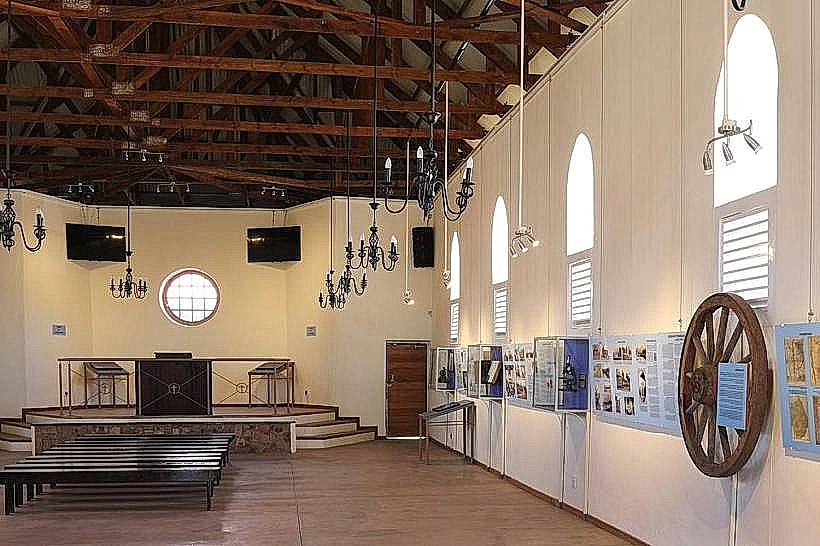
Landmark: Old Stone Church Museum
City: Manzini
Country: Eswatini
Continent: Africa
Old Stone Church Museum, Manzini, Eswatini, Africa
The Old Stone Church Museum is a historical ecclesiastical building and cultural heritage site located in the central district of Manzini, Eswatini. Originally constructed as one of the earliest permanent religious structures in the area, the building has been preserved and converted into a local museum that documents the early missionary history, colonial architecture, and civic development of the township.
Visual Characteristics
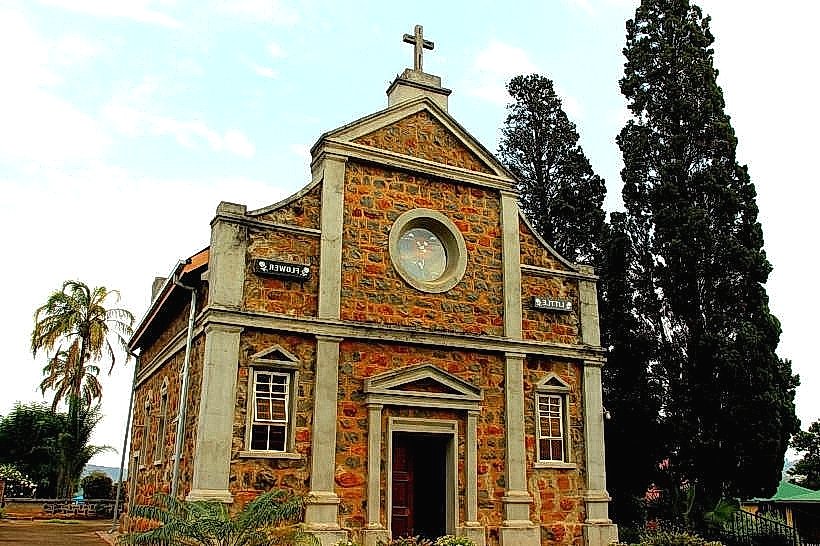
The building is constructed from locally quarried ironstone blocks, which display a weathered palette of deep grays, ochres, and rust browns. The architectural design reflects a traditional colonial gothic style, featuring narrow pointed-arch window frames, a steeply pitched corrugated iron roof, and heavy timber double doors at the main entrance. The thick masonry walls provide a massive structural footprint, while the interior features exposed wooden roof trusses, polished concrete floors, and dedicated glass exhibition cases arranged along the perimeter walls.
Location & Access Logistics
The museum is situated in the administrative and historical zone of central Manzini, located approximately 0.7 kilometers northwest of the Manzini Market. It is fully integrated into the urban street grid and can be reached on foot via the sidewalks connecting from Ngwane Street. For visitors arriving by public transport, the site is within a 10-minute walk of the central Manzini Bus Rank. Drivers can access the property from the MR3 highway via city center link roads; limited parking is available in the dedicated paved bays directly in front of the museum enclosure and along the adjacent municipal street shoulders.
Historical & Ecological Origin
The church was constructed in the early 20th century by European missionaries to serve as a spiritual and educational center for the growing settlement of Bremersdorp (later renamed Manzini). It survived the structural devastation of the Anglo-Boer War in 1902, during which much of the surrounding township was destroyed by fire. Following the construction of larger, modern worship facilities in the mid-1900s, the municipal and cultural authorities decommissioned the church as a house of worship and formally opened it as a municipal museum to safeguard historical artifacts from the region's early foundation era.
Key Highlights & Activities
Examining historical photographs, colonial documents, and early maps of the Swaziland Middleveld region is the primary educational activity inside the facility. Visitors can view collections of early diagnostic medical tools, traditional Swazi cultural attire from the late 19th century, and industrial artifacts from the first commercial shops in the area. Photographic documentation of the exterior ironstone masonry and the gothic window frames provides a distinct look at pre-modern construction techniques in Eswatini.
Infrastructure & Amenities
The museum features indoor exhibition rooms that offer complete shade and shelter from outdoor weather conditions. Restroom facilities are available for visitors within the municipal complex grounds immediately adjacent to the building. The surrounding property features small paved walkways and minimal natural shade from low-level landscaping. Cellular network coverage is exceptional, providing stable 4G and 5G signals from all local service providers. While no food or beverage vendors operate inside the museum, its central urban location provides immediate access to supermarkets and restaurants within a 300-meter radius.
Best Time to Visit
The museum is generally open to the public Monday through Friday from 09:00 to 16:00, remaining closed on Sundays and national public holidays. The optimal time for interior viewing and study is during mid-morning between 10:00 and 12:00, when natural light fills the exhibition spaces through the pointed-arch windows. For exterior architectural photography, the late afternoon light illuminates the textured ironstone blocks without creating harsh overhead glare. The cool, dry winter months from May to August offer the most comfortable outdoor walking conditions.
Facts & Legends
A verified historical oddity of the building is that its thick ironstone walls were utilized as a temporary ballistic shelter and communications outpost during early regional skirmishes, owing to the fact that it was one of the few non-combustible stone structures standing in the entire district at the time. Local historical narratives frequently note that several prominent early families of different nationalities are recorded in the original parish logs preserved inside, making the building the common genealogical anchor point for the modern diverse merchant community of Manzini.
Nearby Landmarks
Cathedral of Our Lady of Assumption: 0.3km South
Somhlolo Park: 0.6km Southeast
King Sobhuza I Statue: 0.6km Southeast
Manzini National Library: 0.6km Southeast
Manzini Market: 0.7km Southeast