Landmark: Kakum National Park
City: Cape Coast
Country: Ghana
Continent: Africa
Kakum National Park, Cape Coast, Ghana, Africa
Kakum National Park is a 375-square-kilometer protected rainforest reserve located in the Central Region of Ghana. It is primarily known for its high-altitude canopy walkway, which serves as a center for ecotourism and biodiversity conservation within the Upper Guinean forest hotspot.
Visual Characteristics
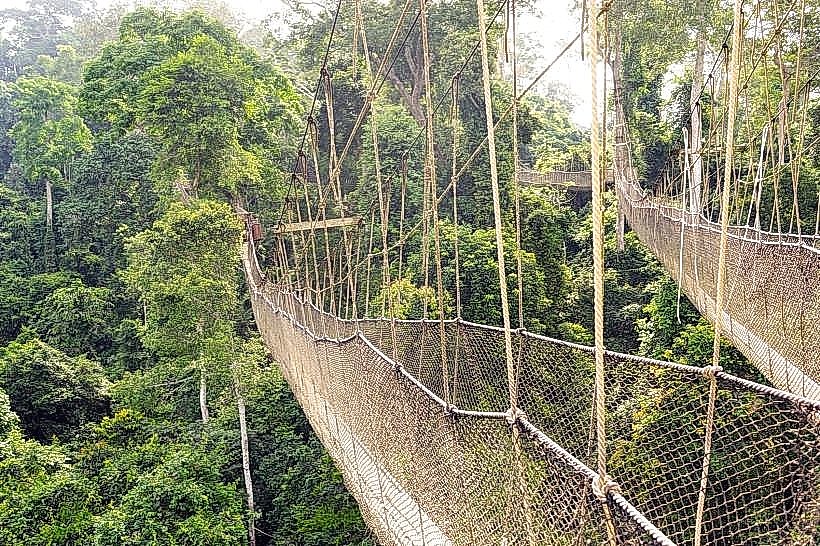
The park consists of dense, multi-layered moist evergreen and semi-deciduous rainforest. The vegetation is characterized by tall hardwood trees, such as Mahogany and Silk Cotton (Ceiba pentandra), reaching heights of up to 65 meters. The forest floor is covered in thick undergrowth, ferns, and medicinal herbs, while the canopy is a continuous expanse of dark green foliage broken only by the headwaters of the Kakum River and its tributaries.
Location & Access Logistics
The entrance is located off the R82 highway near the village of Abrafo, approximately 33km north of Cape Coast. Visitors can reach the park via a 45-minute drive from Cape Coast or a 3-hour drive from Accra. Public transport options include "tro-tros" (minibuses) departing from the Kotokuraba Market station in Cape Coast toward Jukwa/Abrafo. A paved on-site parking lot is available for private vehicles and tour buses.
Historical & Ecological Origin
The area was first established as a forest reserve in 1931 and was gazetted as a national park in 1992. Unlike many other parks, its protected status was initiated by the local community rather than the central government. Geologically, it sits within the Guineo-Congolian ecological zone and serves as a vital watershed, with the Kakum River providing the primary water source for over 130 surrounding towns and villages.
Key Highlights & Activities
The central attraction is the Canopy Walkway, a 350-meter long series of seven suspension bridges elevated 40 meters above the forest floor. Additional activities include guided "Medicinal Plant" hikes along the Kuntan Trail and birdwatching tours on the Sun Bird Trail. Specialized night tours and forest elephant tracking are available by advanced arrangement with park rangers.
Infrastructure & Amenities
The Welcome Center features a restaurant, a souvenir shop, and a wildlife education exhibit. Public restrooms and a designated picnic area are located near the main entrance. While 4G/5G cell signal is generally stable at the Welcome Center and on the elevated canopy walkway, reception is intermittent or non-existent in the deeper forest valleys.
Best Time to Visit
The optimal period for visiting is the dry season from November to March, when trails are less muddy and humidity is lower. For wildlife photography, the early morning (06:00–08:30) provides the highest probability of spotting primates and bird species like the African grey parrot. During the rainy season (May–July), the forest is more vibrant, but the canopy walkway may close temporarily during heavy thunderstorms.
Facts & Legends
The canopy walkway was constructed in 1995 without the use of a single nail or bolt driven into the trees; instead, it utilizes a system of steel cables and pressure pads to protect the bark and ensure the structural integrity of the living supports. Local tradition holds that certain sections of the forest are inhabited by ancestral spirits, leading to the preservation of specific "sacred groves" that remain undisturbed by modern trails.
Nearby Landmarks
Abrafo Village – 2.0km South
Hansi’s Tropical Botany Garden – 4.5km Southeast
Jukwa Village – 4.8km South
Assin Attandanso Resource Reserve – 0.1km North (Contiguous)