Landmark: Arc de Triomphe
City: Paris
Country: France
Continent: Europe
Arc de Triomphe, Paris, France, Europe
The Arc de Triomphe de l'Étoile is one of the most iconic monumental arches in the world, standing at the center of Place Charles de Gaulle (formerly Place de l'Étoile) at the western end of the Champs-Élysées. It serves as a national focal point for French patriotism and military history.
Visual Characteristics
The monument stands 50 meters (164 feet) high, 45 meters wide, and 22 meters deep. It is designed in the Neoclassical style, inspired by the Roman Arch of Titus. The exterior is adorned with four major sculptural groups at the base of the pillars, the most famous being Le Départ de 1792 (commonly known as La Marseillaise). The attic is engraved with the names of major Revolutionary and Napoleonic victories, while the inner walls list the names of 660 military leaders, with those who died in battle underlined.
Location & Access Logistics
Situated in the 8th arrondissement, the arch is the nexus of 12 radiating avenues. Do not attempt to cross the traffic circle on foot. Access is strictly via a pedestrian underground tunnel (Passage du Souvenir) located at the top of the Champs-Élysées or Avenue de la Grande Armée. The site is served by the Métro and RER A station Charles de Gaulle–Étoile (Lines 1, 2, and 6).
Historical Origin
Commissioned by Napoleon I in 1806 following his victory at the Battle of Austerlitz, the arch was intended to honor the French imperial armies. Construction was halted after Napoleon's abdication and was eventually completed in 1836 during the reign of King Louis-Philippe. In 1921, the Tomb of the Unknown Soldier was interred beneath the arch to commemorate the dead of World War I.
Key Highlights & Activities
The Eternal Flame: An eternal flame has burned at the Tomb of the Unknown Soldier since 1923; it is rekindled every evening at 18:30 in a formal ceremony.
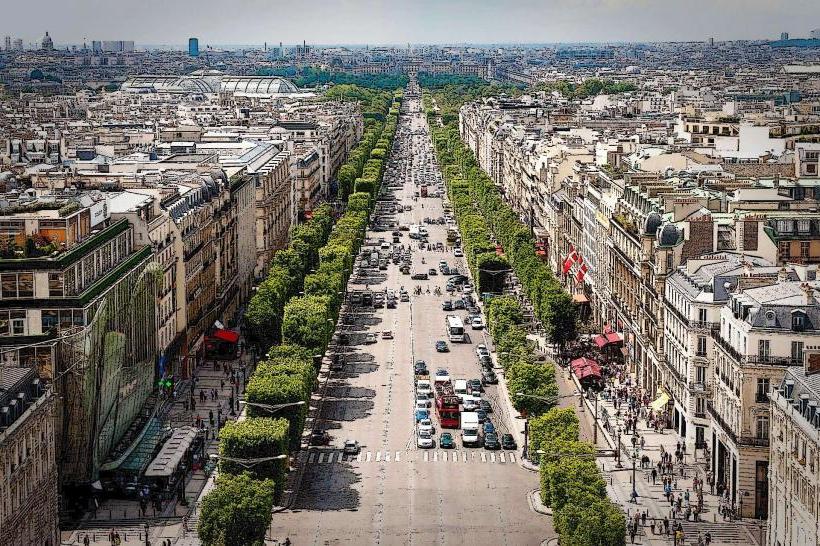
The Observation Deck: A staircase of 284 steps (or a small elevator for those with mobility needs) leads to the terrace. It offers a unique symmetrical view of the 12 radiating avenues and an unobstructed line of sight to the Eiffel Tower and the Louvre.
Small Museum: Located just below the terrace, it provides historical context on the construction and the ceremonies held at the site.
Infrastructure & Amenities
The site features a gift shop and restrooms on the attic level. 5G and 4G mobile signals are robust. The ground-level area around the Tomb is free to access; tickets are required only to ascend to the top. Security screenings are mandatory at the entrance of the underground passage.
Best Time to Visit
The arch is best visited in the late afternoon or evening. This allows visitors to witness the rekindling ceremony at 18:30 and see the city lights align along the "Axe Historique." Daytime visits are optimal for studying the intricate bas-reliefs.
Facts & Legends
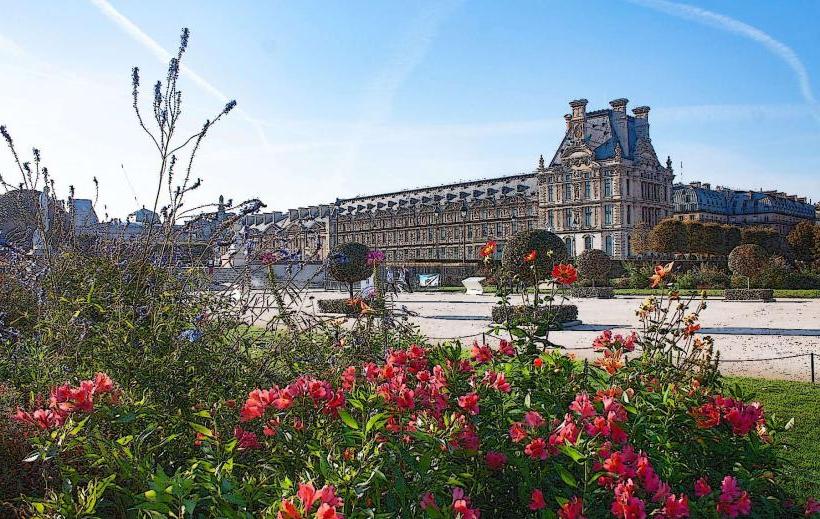
The "Axe Historique" (Historical Axis) is a line of monuments that runs from the Louvre, through the Tuileries Garden and Place de la Concorde, up the Champs-Élysées to the Arc de Triomphe, and ends at the Grande Arche de la Défense. A local historical fact: a small French plane was famously flown through the arch's span by Charles Godefroy in 1919 to honor the pilots of WWI.
Nearby Landmarks
Champs-Élysées: 0.1km East
Place de la Concorde: 2.2km East
Eiffel Tower: 2.1km South
Parc Monceau: 1.1km Northeast
Palais de Tokyo: 1.3km Southeast