Landmark: Place de la Concorde
City: Paris
Country: France
Continent: Europe
Place de la Concorde, Paris, France, Europe
Place de la Concorde is the largest public square in Paris, covering approximately 19 acres at the eastern end of the Champs-Élysées in the 8th arrondissement. It is a major site of French historical significance and a central axis for the city's urban design.
Visual Characteristics
The square is an octagonal expanse defined by its two monumental fountains-the Fontaine des Mers and the Fontaine des Fleuves-and the Luxor Obelisk at its center. It is bordered by the Tuileries Garden to the east and the Champs-Élysées to the west. Two identical neoclassical stone buildings, the Hôtel de la Marine and the Hôtel de Crillon, dominate the northern side. Eight statues representing major French cities (including Lille, Strasbourg, and Marseille) are positioned at the corners of the octagon.
Location & Access Logistics
Situated between the Seine and the Rue de Rivoli, the square is a primary traffic hub. It is served by the Métro station Concorde (Lines 1, 8, and 12). Pedestrian access is via the Tuileries Garden or the sidewalks of the radiating avenues. Due to high-speed traffic circling the center, pedestrians must use designated crosswalks to reach the central obelisk.
Historical Origin
Designed by Ange-Jacques Gabriel in 1755 as "Place Louis XV," the square was renamed "Place de la Révolution" during the French Revolution. It was the site of the guillotine, where King Louis XVI, Marie Antoinette, and Maximilien Robespierre were executed. In 1795, it was renamed "Place de la Concorde" to symbolize national reconciliation. The Luxor Obelisk, a 3,300-year-old Egyptian artifact, was gifted to King Louis-Philippe by Muhammad Ali Pasha and installed in 1836.
Key Highlights & Activities
The Luxor Obelisk: A 23-meter yellow granite monolith covered in hieroglyphics, functioning as the world's largest gnomon (part of a sundial).
Hôtel de la Marine: A recently restored 18th-century palace now open to the public as a museum showcasing royal apartments and state rooms.
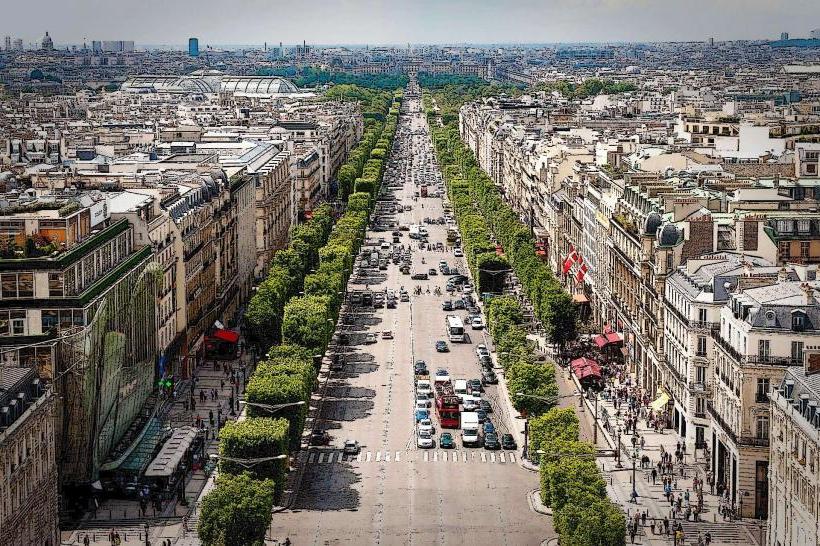
Photography: The square offers a clear "Historical Axis" view from the Louvre through to the Arc de Triomphe.
Events: It is a focal point for the July 14th military parade and served as a primary venue for urban sports during the 2024 Olympic Games.
Infrastructure & Amenities
The square is an open urban space with no natural shade. Public restrooms are located nearby in the Tuileries Garden and the underground Métro station. 5G and 4G mobile signals are strong. The pavement is mostly flat but consists of large paving stones which can be uneven. High-end dining and cafes are located in the surrounding streets and the Hôtel de Crillon.
Best Time to Visit
The square is best viewed at night when the fountains and the obelisk's gold-leafed cap (pyramidion) are illuminated. Morning visits (before 09:00) allow for easier movement across the square before peak traffic congestion.
Facts & Legends
The Luxor Obelisk originally stood at the entrance of the Luxor Temple in Egypt; its twin remains there today. A local detail: the statues of the cities were once used as small residences for watchmen in the 19th century. The square's fountains were modeled after those at St. Peter's Square in Rome.
Nearby Landmarks
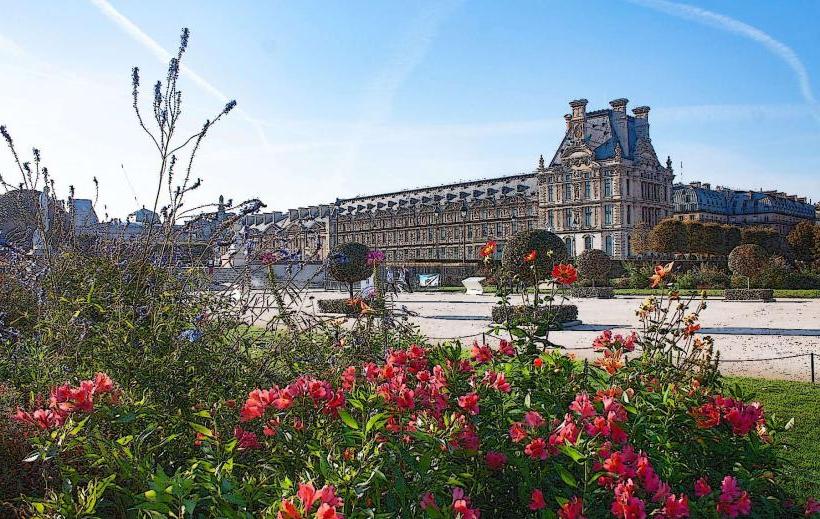
Tuileries Garden: 0.1km East
Champs-Élysées: 0.1km West
Orangerie Museum: 0.2km South
Hôtel de la Marine: 0.05km North
Pont de la Concorde: 0.1km South (crosses the Seine)