Landmark: Montmartre
City: Paris
Country: France
Continent: Europe
Montmartre, Paris, France, Europe
Montmartre is a historic hill and district in the 18th arrondissement of Paris, reaching an elevation of 130 meters. It is primarily known for its artistic history, bohemian atmosphere, and the white-domed Sacré-Cœur Basilica that sits at its summit.
Visual Characteristics
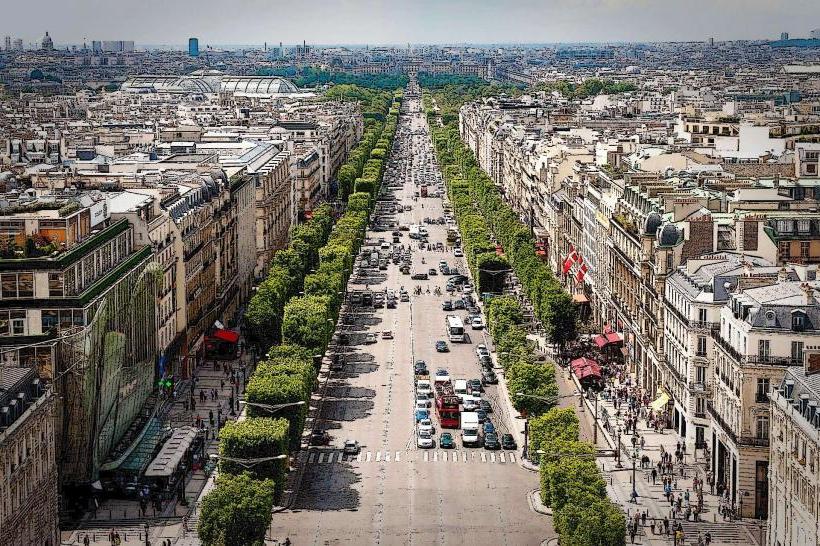
The district is characterized by steep, narrow cobblestone streets, hidden stairways, and ivy-covered buildings. Unlike the wide Hausmannian boulevards of central Paris, Montmartre retains a village-like aesthetic. The architecture is a mix of 19th-century houses, small squares, and the remaining historic windmills (moulins) that once dominated the landscape.
Location & Access Logistics
Montmartre is located in northern Paris. Primary Métro access points are Anvers (Line 2) for the basilica, Abbesses (Line 12) for the village center, and Blanche (Line 2) for the Moulin Rouge. The Montmartre Funicular transports visitors from the base of the hill near Square Louise Michel to the Sacré-Cœur. Vehicle access is highly restricted and difficult due to the narrow, one-way streets; the "Petit Train de Montmartre" provides a tourist circuit from Place Blanche.
Historical Origin
Once a separate village outside the city walls of Paris, Montmartre was the site of the martyrdom of Saint Denis (first Bishop of Paris) around 250 CE. During the Belle Époque (late 19th to early 20th century), it became the center of the Parisian avant-garde. Artists such as Picasso, Dalí, Modigliani, and Van Gogh lived and worked here, attracted by the low rents and the vibrant nightlife of the local cabarets.
Key Highlights & Activities
Place du Tertre: The central square where artists set up easels to paint portraits and caricatures for tourists.
Sacré-Cœur Basilica: Offers a panoramic view of Paris from its parvis and dome.
Le Mur des Je t'aime (I Love You Wall): A blue-tiled wall featuring "I love you" written in over 250 languages.
Moulin de la Galette: One of the two remaining historic windmills, famously painted by Renoir.
Bateau-Lavoir: The former studio complex where Picasso painted Les Demoiselles d'Avignon.
Infrastructure & Amenities
The district is densely packed with independent boutiques, galleries, and traditional French bistros. Public restrooms are available at the base of the funicular and in the Place du Tertre. 5G/4G signals are strong throughout the hill. Due to the steep inclines and hundreds of stairs, the area presents significant navigation challenges for mobility-impaired visitors, though the funicular and specific bus routes mitigate this.
Best Time to Visit
To experience the village atmosphere without extreme congestion, visit on weekday mornings before 10:00. Sunset is the peak time for the parvis of the Sacré-Cœur. Avoid the main tourist path from Anvers to the Basilica during summer weekends if seeking a quieter experience; instead, explore the northern slopes near Lamarck-Caulaincourt.
Facts & Legends
The name Montmartre is believed to derive from Mons Martyrum (Mount of Martyrs). A local curiosity is the Clos Montmartre, a small functional vineyard on the northern slope that still produces approximately 1,500 bottles of wine annually. Legend tells of Saint Denis, who reportedly picked up his severed head after execution and walked six kilometers while preaching.
Nearby Landmarks
Sacré-Cœur Basilica: 0.1km East
Moulin Rouge: 0.8km Southwest
Montmartre Cemetery: 0.9km West
Dalí Paris Museum: 0.2km West
Musée de Montmartre: 0.3km North