Landmark: Musee de L Orangerie
City: Paris
Country: France
Continent: Europe
Musee de L Orangerie, Paris, France, Europe
The Musée de l'Orangerie is an art gallery of impressionist and post-impressionist paintings located in the west corner of the Tuileries Garden in the 1st arrondissement of Paris. It is most famous as the permanent home of Claude Monet’s monumental Water Lilies (Nymphéas) cycle.
Visual Characteristics
The museum is housed in a former greenhouse, characterized by its elongated rectangular shape and glass-walled northern facade. The interior’s primary feature is two oval rooms designed by Monet himself to house the Water Lilies. these rooms use natural overhead light to illuminate the curved canvases. The lower level houses the Jean Walter and Paul Guillaume Collection, featuring modern masterpieces in more traditional gallery settings.
Location & Access Logistics
The museum is situated on the Place de la Concorde side of the Tuileries. It is accessible via the Métro station Concorde (Lines 1, 8, and 12). Entrance is via a ramp and stairs at the western end of the garden. Advanced time-slot reservations are mandatory due to the limited capacity of the oval rooms. Visitors with the "Musée d'Orsay-Musée de l'Orangerie" combined ticket have dedicated entry lines.
Historical Origin
The building was constructed in 1852 by architect Firmin Bourgeois to shelter the orange trees of the Tuileries Garden during winter. It was converted into a museum after World War I when Claude Monet donated the Nymphéas to the French state as a symbol of peace. The "Walter-Guillaume" collection was acquired in the 1960s and 1980s, expanding the museum's scope beyond Monet.
Key Highlights & Activities
The Nymphéas: Eight massive panels (2 meters high, totaling 91 meters in length) arranged across two oval rooms.
Walter-Guillaume Collection: Significant works by Renoir, Cézanne, Modigliani, Picasso, Matisse, Derain, and Soutine.
The Sculptures: The exterior features notable sculptures, including works by Auguste Rodin.
Infrastructure & Amenities
The museum includes a boutique/bookstore and a small cafe on the lower level. Public restrooms are available. 5G and 4G mobile signals are strong. The entire museum is fully accessible to mobility-impaired visitors via elevators and ramps. A strict silence policy is often enforced in the Water Lilies rooms.
Best Time to Visit
The museum is closed on Tuesdays. To experience the Water Lilies in natural light, visit on a bright, slightly overcast morning (09:00–11:00). The first and last entry slots are the least crowded. It is generally quieter than the nearby Louvre or Musée d’Orsay.
Facts & Legends
Monet designed the oval rooms to create an "illusion of an endless whole, of water without horizon and without shore." During the 1944 Liberation of Paris, the museum was hit by shells, but the Water Lilies panels, which were protected by a brick wall at the time, remained undamaged.
Nearby Landmarks
Place de la Concorde: 0.1km West
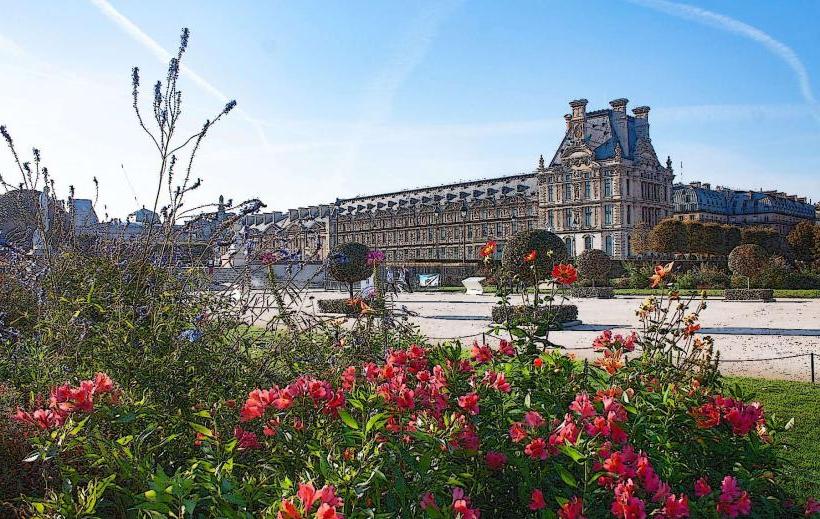
Tuileries Garden: 0.1km East
Musée d'Orsay: 0.5km South (across the Passerelle Léopold-Sédar-Senghor)
Jeu de Paume (Photography Museum): 0.1km North
Louvre Museum: 0.9km East