Landmark: Notre Dame Cathedral
City: Paris
Country: France
Continent: Europe
Notre Dame Cathedral, Paris, France, Europe
Notre-Dame de Paris is a medieval Catholic cathedral located on the Île de la Cité in the 4th arrondissement of Paris. It is widely considered the finest example of French Gothic architecture, renowned for its pioneering use of flying buttresses and rib vaults.
Visual Characteristics
The cathedral is defined by its twin western towers, which stand 69 meters tall, and its extensive use of sculptural elements, including iconic stone gargoyles and chimeras. The exterior features three monumental portals-the Portals of the Virgin, the Last Judgment, and Saint Anne. Inside, the structure is famous for its three massive rose windows (North, South, and West) dating back to the 13th century, which retain much of their original medieval glass.
Location & Access Logistics
The cathedral is situated at 6 Parvis Notre-Dame - Pl. Jean-Paul II. It is accessible via the Métro at stations Cité (Line 4) or Hôtel de Ville (Lines 1 and 11), and the RER B and C at station Saint-Michel Notre-Dame. Following the 2019 fire, public access to the square (parvis) has been restored, and the cathedral is scheduled to reopen to the public for religious services and tourism in late 2024.
Historical Origin
Construction began in 1163 under Bishop Maurice de Sully and was largely completed by 1260, though modifications continued for centuries. It was the site of the coronation of Napoleon I in 1804 and the funeral services of numerous French presidents. In the mid-19th century, architect Eugène Viollet-le-Duc led a major restoration, which included the addition of the iconic (now destroyed and rebuilt) lead-covered oak spire.
2019 Fire and Restoration
On April 15, 2019, a massive structural fire broke out under the roof, resulting in the collapse of the 19th-century spire and the destruction of the "Forest" (the medieval oak roof timbering). A global restoration project has since succeeded in stabilizing the structure, cleaning the interior stone, and reconstructing the spire and roof to their original specifications using traditional medieval techniques and materials.
Key Highlights & Activities
Prior to the fire, visitors could ascend the South Tower to view the "Bourdons" (great bells) and walk the gallery of chimeras. Key internal highlights include the Great Organ, one of the most famous musical instruments in the world, and the Treasury, which houses the Holy Crown of Thorns. Currently, an outdoor exhibition around the perimeter fence details the progress of the reconstruction.
Infrastructure & Amenities
The surrounding area is a high-traffic pedestrian zone with numerous cafes and bookstores. Public restrooms are located beneath the parvis in the Espace Notre-Dame. 5G and 4G mobile signals are exceptionally strong. Accessibility is being modernized during the restoration to ensure the cathedral meets current standards for mobility-impaired visitors upon reopening.
Facts & Legends
The cathedral is the setting for Victor Hugo’s 1831 novel The Hunchback of Notre-Dame, which was instrumental in spurring the 19th-century restoration movement. A brass plate in the parvis marks Point Zéro, the literal center of Paris from which all road distances in France are measured.
Nearby Landmarks
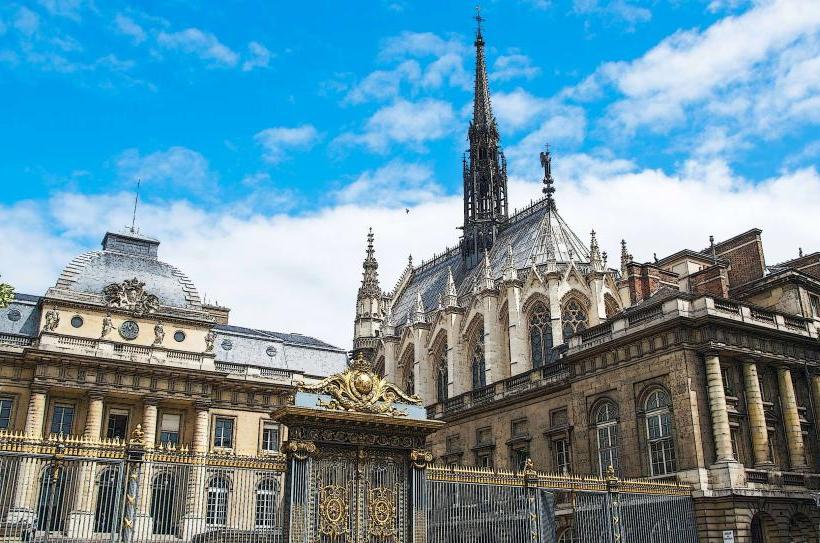
Sainte-Chapelle: 0.4km West
Conciergerie: 0.5km West
Shakespeare and Company Bookstore: 0.2km South (across the Seine)
Hôtel de Ville: 0.4km North
Île Saint-Louis: 0.3km East