Landmark: Mbabane Market
City: Mbabane
Country: Eswatini
Continent: Africa
Mbabane Market, Mbabane, Eswatini, Africa
Mbabane Market is a centralized urban trading complex located in the downtown commercial core of Mbabane, the executive capital of Eswatini. The facility serves as the primary hub for both local agricultural commerce and traditional Swati craft distribution within the Hhohho District.
Visual Characteristics
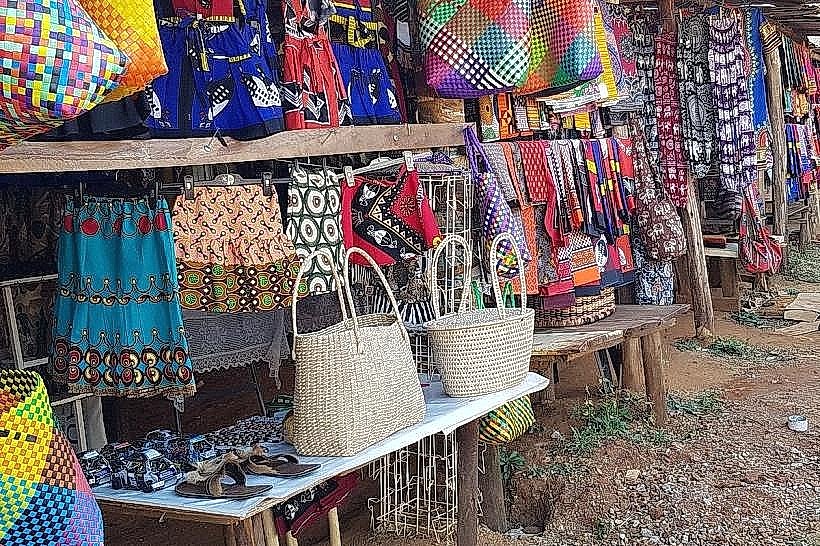
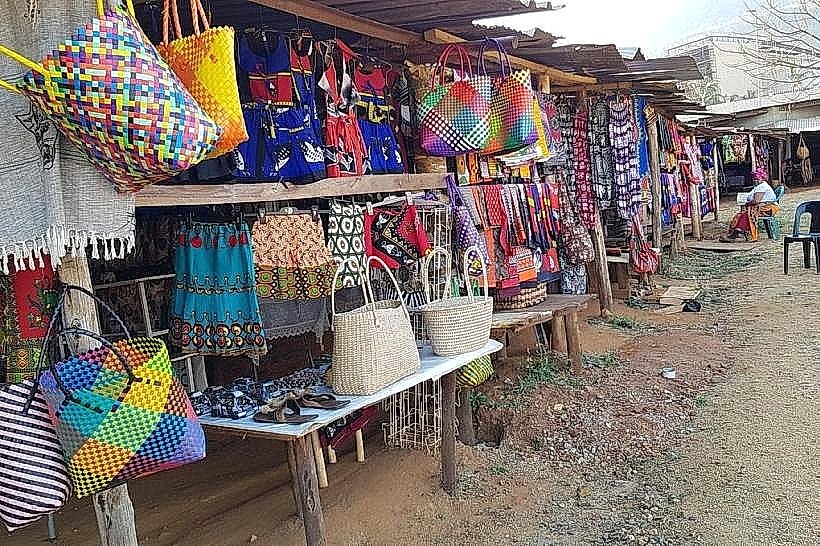
The market consists of a dual-structure layout comprising a large, open-air municipal pavilion and an adjacent covered concrete hall topped with a high corrugated iron roof. The agricultural section features long, linear rows of concrete benches piled with green, yellow, and red tropical produce, while the craft sector is characterized by dense vertical displays of woven grass, dark soapstone, carved wooden sculptures, and multi-colored beadwork textiles. The floor surfaces are entirely cast concrete, bisected by narrow footpaths and bordered by perimeter brick walls.
Location & Access Logistics
The site is positioned directly on Allister Miller Street, the primary commercial thoroughfare in central Mbabane, immediately adjacent to the Swazi Plaza shopping complex. It sits roughly 1 kilometer northeast of the main Mbabane Bus Rank, making it easily accessible via a 10-minute walk along Mbandzeni Road. Public transport via local minibuses (kombis) stops continuously along Allister Miller Street directly outside the market gates. Vehicular parking is available in the surrounding metered municipal street bays and the multi-story paved parkade at the adjacent Swazi Plaza.
Historical & Ecological Origin
The market developed organically during the mid-20th century as Mbabane expanded its role as the colonial administrative capital under British rule, formalizing the trade routes that crossed the Mbabane River. It was later structurally regularized and upgraded by the Municipal Council of Mbabane to provide permanent shelter and sanitation for informal vendors moving from rural regions. The crafts sold inside the facility utilize localized ecological raw materials harvested from the surrounding Highveld, including indigenous sisal fibers, mountain grasses, harvested hardwood tree species, and locally gathered traditional medicinal plants.
Key Highlights & Activities
The main activity is self-guided walking commerce through the separate produce, craft, and traditional medicine sections. Visitors can observe artisans actively manufacturing beadwork patterns or weaving dyed lutindzi grass baskets directly behind their display counters. The rear section of the market features traditional food stalls where consumers can purchase and consume prepared indigenous Swazi dishes like sishwala (thick porridge) and umfino (maize porridge mixed with wild greens).
Infrastructure & Amenities
The facility is equipped with basic municipal infrastructure, including centralized public restrooms, overhead electrical lighting in the covered sections, and concrete drainage channels along the floor aisles. High-speed cellular network connectivity (4G/5G) is fully operational throughout the indoor and outdoor zones due to the central urban location. While some established craft vendors utilize electronic mobile money or card terminals, the majority of the produce vendors operate strictly via physical cash transactions.
Best Time to Visit
The market is open year-round, but the peak period for activity occurs on Fridays and Saturdays from 07:00 to 12:00, when rural farmers and artisans arrive to restock the stalls. The early morning hours between 07:00 and 09:00 offer the optimal lighting and lowest crowd density for photography of the produce displays. The dry winter months from May to August provide the most comfortable ambient conditions for exploration, as the uninsulated corrugated iron roofing generates intense internal heat during the summer wet season from November to March.
Facts & Legends
A specialized section of the market is dedicated to traditional Swazi medicine (Muthi), where licensed herbalists display dried roots, bark, animal skins, and mineral compounds used in traditional healing practices. Local urban lore states that certain prominent vendors possess ancestral knowledge that allows them to prescribe specific herbal mixtures capable of deflecting bad luck and ensuring commercial success for the businesses operating in the capital.
Nearby Landmarks
Swazi Plaza - 0.2km West
Hilton Garden Inn Mbabane - 0.4km West-Southwest
Mbabane City Hall - 0.7km Southwest
All Saints Cathedral - 1.1km Southwest
Pine Valley (Base of Sibebe) - 4.2km North