Landmark: Sibebe Rock
City: Mbabane
Country: Eswatini
Continent: Africa
Sibebe Rock, Mbabane, Eswatini, Africa
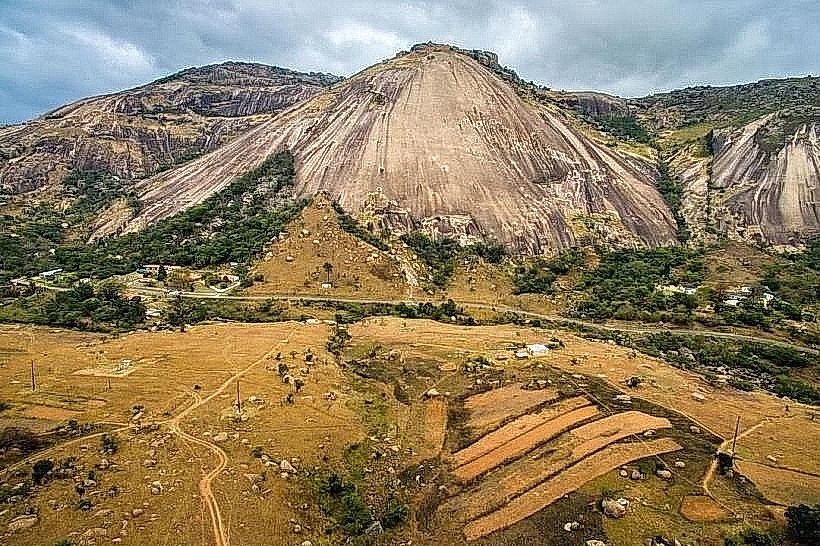
Sibebe Rock is an ancient volcanic granite monolith located in the Pine Valley region of Eswatini, directly north of the capital city. It stands as the largest plutonic granite dome in Africa and the second-largest exposed single piece of rock on Earth.
Visual Characteristics
The landmark is a massive, bulbous plutonic dome composed entirely of three-billion-year-old grey and buff-colored granite. It rises steeply to an elevation of 1,488 meters above sea level, featuring sheer, vertical cliff faces streaked with black water stains and orange lichen on its southern aspect. The upper surface transitions into a vast plateau characterized by wind-sculpted boulders, shallow solution pans, fractures, and patches of dense, high-altitude grassland interspersed with indigenous riverine scrub inside deep fissures.
Location & Access Logistics
The site is situated approximately 10 kilometers north of central Mbabane. Access is achieved by driving north from the city center via the paved Pine Valley Road, which runs parallel to the base of the formation, before transitioning onto a graded dirt road for the final segment. Public transport via local minibuses (kombis) operates from the Mbabane Bus Rank toward Pine Valley, though they drop passengers 1 to 2 kilometers short of the main trailhead. Unsecured gravel parking areas are available at the Sibebe Trails community project base and near the adjacent resort infrastructure.
Historical & Ecological Origin
Geologically, the formation is a massive granite pluton that intruded into the Earth's crust during the Archean Eon approximately 3 billion years ago. Over hundreds of millions of years, the overlying softer sedimentary and volcanic layers eroded away, exposing the crystalline core through a process of tectonic uplift and spheroidal weathering. Ecologically, it is classified as a montane grassland ecosystem isolated by sheer rock barriers, serving as a critical refuge for rare species such as the threatened blue swallow and specialized cliff-dwelling raptors.
Key Highlights & Activities
Hiking is the primary activity, with the steep "Sibebe Survivor" trail providing a direct route to the summit plateau that requires 1 to 2 hours of ascent. Navigating the top reveals network pathways leading to hidden caves, perennial waterfalls, and deep granite potholes filled with rainwater. Technical rock climbing and bouldering are conducted on the sheer southern faces, while birdwatching for rare endemic species is optimal along the lower, vegetated valley edges.
Infrastructure & Amenities
The natural site lacks developed public utilities, meaning there are no public restrooms, built shelters, or formal waste disposal facilities along the trails or on the summit plateau. Cellular network reception (4G/5G) is reliable across most parts of the mountain due to proximity to the capital, though signals drop inside deep rock fractures. Food vendors and modern amenities, including treated water and sit-down dining, are absent on the trails but can be accessed at the commercial resort properties operating near the base.
Best Time to Visit
The optimal period for hiking is during the dry winter months from May to August, when ambient temperatures are cool and the risk of rain is minimal. Midday temperatures in summer cause the bare granite surface to overheat, making early morning departures between 06:00 and 08:00 critical. Photography is best executed during the golden hours of early morning or late afternoon, when low-angle sunlight highlights the texture, fissures, and color variations of the stone surface. Summer afternoons from November to March must be avoided due to frequent, severe electrical storms that pose a lightning strike hazard on the exposed summit.
Facts & Legends
Local Swati tradition holds that the rock possesses a spiritual presence, and historically, community members avoided pointing directly at the formation out of respect for the ancestors believed to dwell within its caves. A modern athletic tradition is the annual Sibebe Survivor challenge, a grueling community charity walk where thousands of participants attempt to conquer the steepest face of the mountain to raise funds for local medical and social initiatives.
Nearby Landmarks
Silverstone Lodge - 2.8km South
Mbabane Market - 4.5km South
All Saints Cathedral - 4.6km South-Southwest
Mbabane City Hall - 4.9km South-Southwest