Landmark: Roman Amphitheatre of Carthage
City: Carthage
Country: Tunisia
Continent: Africa
Roman Amphitheatre of Carthage, Carthage, Tunisia, Africa
The Roman Amphitheatre of Carthage is an ancient structure located in the city of Carthage, Tunisia.
This arena was primarily used for gladiatorial contests and public spectacles during the Roman era.
Visual Characteristics
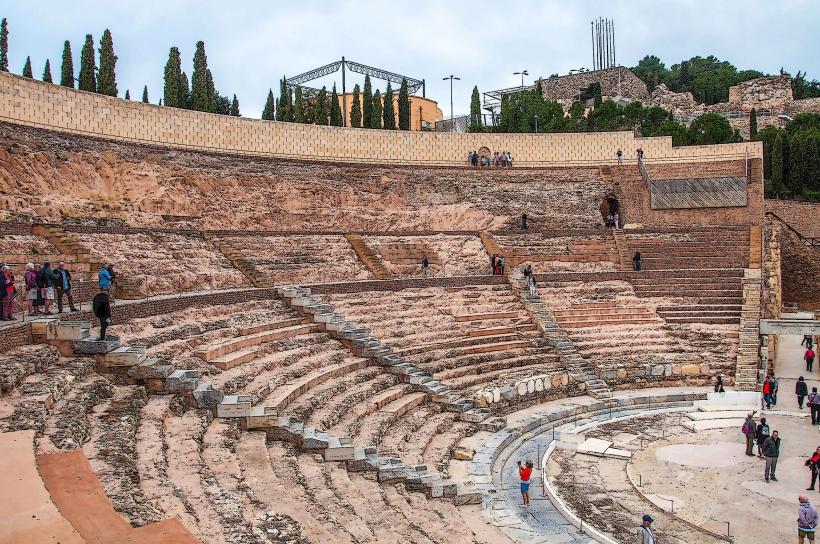
The amphitheatre is constructed from large, roughly cut limestone blocks. Its elliptical shape measures approximately 117 meters along its major axis and 87 meters along its minor axis. The seating tiers, known as the cavea, are largely absent, with only remnants of their foundations visible. The arena floor is a flat expanse of earth and rubble. The remaining walls stand at varying heights, with the highest sections reaching approximately 15 meters.
Location & Access Logistics
The amphitheatre is situated approximately 15 kilometers west of Tunis city center. Access is via the A1 motorway, exiting towards Carthage. Parking is available on adjacent unpaved lots. Public transport options include the TGM train line, disembarking at the Carthage Hannibal station, followed by a 1.5km walk or a short taxi ride. Bus lines 3, 33, and 34 also serve the general Carthage area, requiring further walking.
Historical & Ecological Origin
Construction of the amphitheatre began in the 2nd century AD, likely during the reign of Emperor Hadrian, and was completed by the 3rd century AD. It was built by the Romans to serve the population of Roman Carthage, functioning as a venue for entertainment and public events. The site is located on a geological formation of Pliocene limestone.
Key Highlights & Activities
Visitors can walk the perimeter of the arena floor. Examination of the remaining substructure and seating foundations is possible. Archaeological interpretation boards provide context on the site's history and function. No organized tours are currently offered on-site.
Infrastructure & Amenities
There are no permanent restroom facilities or shade structures at the amphitheatre. Food vendors are not present at the immediate site, but can be found in the nearby modern town of Carthage. Cell phone signal (4G/5G) is generally available.
Best Time to Visit
For optimal lighting conditions for photography, visit in the early morning or late afternoon. The months of April, May, September, and October offer the most temperate weather, with average daily temperatures between 20°C and 25°C. There are no tidal considerations for visiting this inland structure.
Facts & Legends
This amphitheatre was the site of the martyrdom of Saint Perpetua and Saint Felicity in 203 AD, a significant event in early Christian history. The arena was later used as a quarry for building materials in subsequent centuries.
Nearby Landmarks
- Roman Baths of Antoninus (0.8km North)
- Carthage Museum (1.2km North)
- Punic Ports (1.5km Northeast)
- Byrsa Hill (1.3km North)
- Carthage Acropolium (1.1km North)