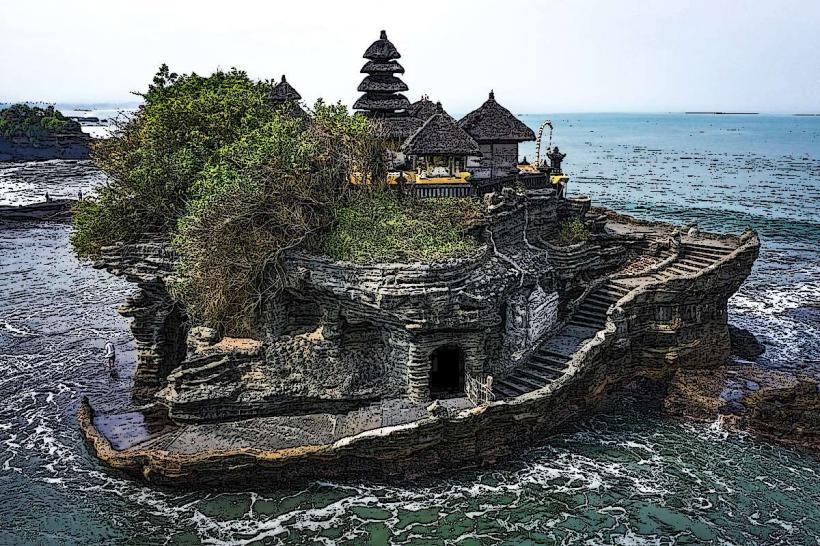
Landmark: Tanah Lot
City: Bali
Country: Indonesia
Continent: Asia
Tanah Lot, Bali, Indonesia, Asia
Tanah Lot is a sea temple located on a rock formation off the coast of Bali, Indonesia.
It is a significant cultural and religious site, particularly known for its offshore setting.
Visual Characteristics
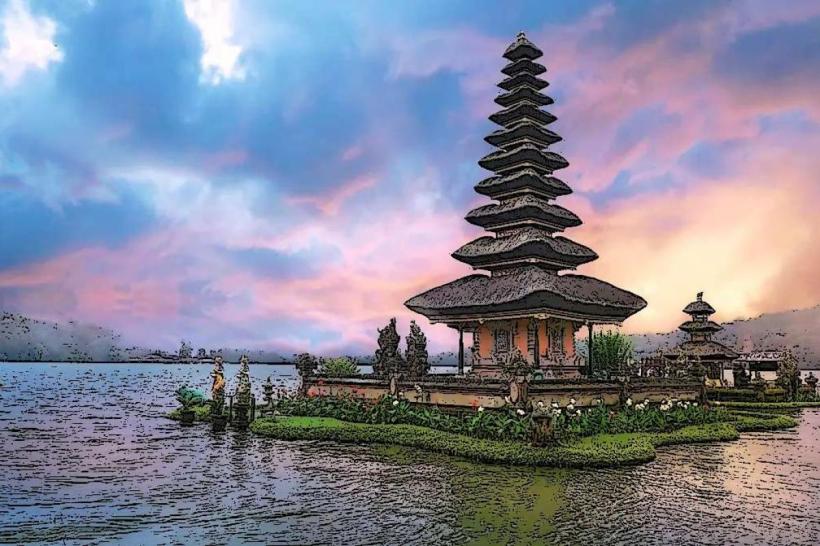
The temple complex is situated on a large offshore rock. The primary temple structure is a multi-tiered pagoda constructed from dark, weathered stone. It is surrounded by smaller shrines and rock formations. The rock itself is dark volcanic stone, often partially submerged by the sea at high tide. The surrounding waters are typically a deep blue, with waves crashing against the base of the rock.
Location & Access Logistics
Tanah Lot is located approximately 20 kilometers northwest of Denpasar, Bali's capital city. Access is via Jalan Raya Tanah Lot, a well-maintained road. Parking is available at designated lots near the entrance, with a fee. Public transport options are limited; private car hire or taxi services are the most common methods of arrival from Denpasar or other tourist areas. From the parking area, a paved pathway leads to the temple entrance, approximately a 5-minute walk.
Historical & Ecological Origin
The construction of Tanah Lot is attributed to the 15th-century Javanese Hindu priest Nirartha. He is said to have established it as a place of worship for the sea god. The rock formation is a result of coastal erosion over millennia, shaped by the Indian Ocean's wave action.
Key Highlights & Activities
Visitors can walk around the base of the rock formation at low tide to observe the temple up close. Photography is a primary activity, especially during sunset. Small caves at the base of the rock are accessible when the tide is low. Local guides are available for hire to explain the temple's history and significance. There are also opportunities to purchase local crafts and souvenirs in the market area leading to the temple.
Infrastructure & Amenities
Restrooms are available in the parking area and near the market. Shaded areas are provided by market stalls and some strategically placed trees along the pathway. Cell phone signal (4G) is generally available. Food vendors and small restaurants are located in the market area adjacent to the temple entrance, offering local Indonesian cuisine.
Best Time to Visit
The best time of day for photography is during the late afternoon, leading up to sunset, due to the quality of light. The best months for weather are generally during the dry season, from April to September, when rainfall is less frequent. Visiting during low tide allows for closer access to the rock formation and the temple's base.
Facts & Legends
A local legend states that the temple is guarded by giant sea snakes, believed to be the transformed sashes of Nirartha's followers. It is also said that a drop of holy water from the temple can bestow good fortune and protection.
Nearby Landmarks
- Echo Beach (2.5km Southwest)
- Batu Bolong Temple (1.8km Southwest)
- Seminyak Beach (15km Southeast)
- Uluwatu Temple (35km South)