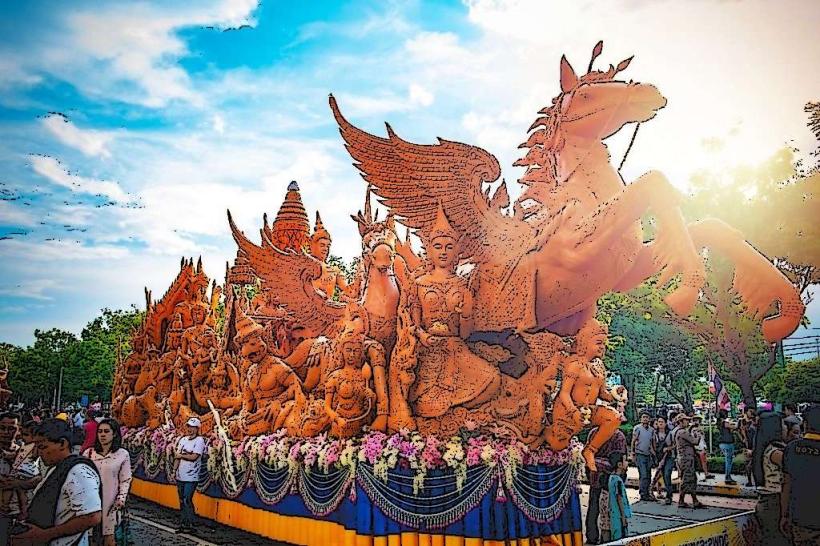
Landmark: Ubon Ratchathani Candle Festival
City: Gulf of Thailand
Country: Thailand
Continent: Asia
Ubon Ratchathani Candle Festival, Gulf of Thailand, Thailand, Asia
The Ubon Ratchathani Candle Festival is an annual event held in Ubon Ratchathani Province, Thailand, celebrating the start of the Buddhist Rains Retreat (Phansa).
This festival is characterized by the display of elaborate, large-scale wax sculptures, often depicting Buddhist themes and local folklore.
Visual Characteristics
The primary visual elements are the intricately carved wax sculptures, which can reach significant heights, sometimes exceeding 10 meters. These sculptures are constructed from beeswax and are often illuminated at night, casting shadows and highlighting the detailed craftsmanship. The festival grounds are typically decorated with banners and lights. The sculptures themselves vary in color depending on the natural hue of the beeswax, with some artists incorporating natural dyes for specific effects.
Location & Access Logistics
The festival is primarily held in the city of Ubon Ratchathani, with the main events often concentrated around the Thung Si Mueang public park and along the Mun River. Access to Ubon Ratchathani can be achieved via Ubon Ratchathani Airport (UBP), which receives domestic flights from Bangkok and other major Thai cities. The city is also connected by rail and bus services. Within the city, taxis, songthaews (shared pick-up trucks), and ride-sharing services are available for local transportation to the festival sites. Parking can be limited in the immediate vicinity of the main event areas during peak times.
Historical & Ecological Origin
The tradition of creating wax candles for the Buddhist Rains Retreat dates back centuries. Monks traditionally used candles to provide light during their meditation and study periods within monasteries. The Ubon Ratchathani Candle Festival evolved from this practice, with local communities and temples competing to create the most impressive wax creations to present to monks at the start of Phansa. The festival officially began in its current organized form in the mid-20th century, growing in scale and popularity.
Key Highlights & Activities
The central activity is the viewing of the large wax sculptures, which are paraded through the city streets before being displayed. Competitions are held for the most artistic and technically proficient sculptures. Cultural performances, including traditional Thai music and dance, often accompany the festival. Visitors can observe the carving process in the days leading up to the main event. Local markets selling handicrafts and food are also present.
Infrastructure & Amenities
Restroom facilities are typically provided at the main festival venues. Shade may be limited in open areas, though some vendor stalls offer cover. Cell phone signal (4G/5G) is generally available within the city. Food vendors are abundant, offering a range of local Thai cuisine. Some areas may have seating, but it is not guaranteed.
Best Time to Visit
The festival typically takes place in July, coinciding with the start of the Buddhist Rains Retreat. The main events, including the parade and sculpture display, usually occur over a weekend. For optimal viewing of the sculptures before they are displayed, visiting a few days prior to the parade is recommended. The best time of day for photography is often in the late afternoon as the light softens, and again in the evening when the sculptures are illuminated.
Facts & Legends
A local belief associated with the festival is that the quality and beauty of the wax sculptures created are indicative of the prosperity and good fortune the community will experience in the coming year. Some older traditions involved monks themselves carving smaller candles, a practice that has largely been replaced by community-led efforts.
Nearby Landmarks
- Wat Phra That Nong Bua (1.5km West)
- Thung Si Mueang (0.2km South)
- Ubon Ratchathani National Museum (0.8km Southwest)
- Wat Supattanaram Worawihan (1.2km West)