Landmark: Mandala House
City: Blantyre
Country: Malawi
Continent: Africa
Mandala House, Blantyre, Malawi, Africa
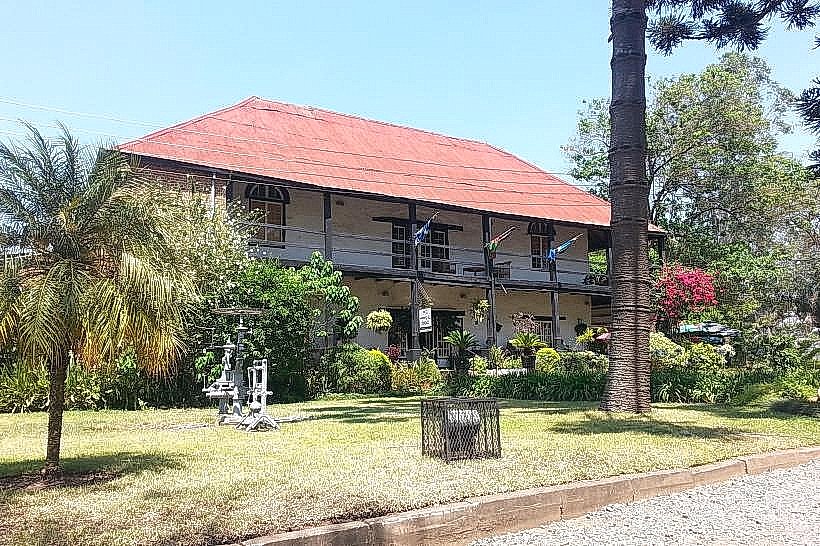
Mandala House is a historic colonial-era mansion and national monument that stands as the oldest surviving European-style structure in Malawi. The property is situated on a landscaped estate in the Mandala residential sector of Blantyre, positioned between Kaohsiung Road and the Mudi River channel.
Visual Characteristics
The landmark is a two-story residential building executed in a classic British colonial architectural style that features deep protective verandas wrapping around both levels. The primary load-bearing walls are constructed from sun-dried clay bricks and mud mortar, finished with a smooth whitewashed plaster coat. The upper veranda is supported by a series of slender timber columns and is enclosed by a decorative wooden balustrade, while the roof infrastructure uses dark corrugated iron sheeting over timber trusses. The internal layout features floors, doors, and a central staircase fabricated from solid native Mulanje Cedar wood, complemented by an original cast-iron bank vault integrated into the ground floor masonry.
Location & Access Logistics
The site is located approximately 1.4 kilometers southeast of the Blantyre central business district on Kaohsiung Road. Private vehicles approach the area by driving south from the city center along Mahatma Gandhi Road, turning east onto Mendeleev Road, and then navigating north onto Kaohsiung Road directly to the main entrance gates. A secure, paved brick parking area is situated within the gated perimeter of the property. Public transit commuters can utilize any local minibus operating the route between Blantyre and Limbe via Gandhi Road, disembarking at the Mandala intersection, and walking 300 meters northeast along the access track to the reception entrance.
Historical & Ecological Origin
Construction of the mansion was completed in 1882 by the African Lakes Corporation, a Scottish commercial enterprise established to support early missionary operations and build trade networks in the region. The building was designed to serve as the chief administrative headquarters for the corporation in Africa and as the private residence for its first joint general managers, brothers John and Frederick Moir. In 1883, a section of the ground floor was converted to house the Standard Bank of South Africa, establishing the first formal banking institution in the territory. The building holds a national historical monument status, representing the onset of permanent European commercial architecture within the Shire Highlands ecosystem.
Key Highlights & Activities
Visitors can complete self-guided structural tours across the exterior verandas and ground-floor display rooms to examine the nineteenth-century masonry work. The building houses the main research library, historical archives, and offices of the Society of Malawi (Historical and Scientific), where public access is permitted to study collection logs and colonial-era journals. The ground floor interior houses the La Caverna Art Gallery, which displays contemporary Malawian landscape paintings, woodcarvings, and ceramics available for procurement, while the perimeter lawns host an outdoor dining patio.
Infrastructure & Amenities
The commercial compound features modern, permanent public restroom blocks equipped with standard plumbing fixtures adjacent to the gallery wing. Extensive shade is provided across the property by the wide architectural overhangs of the verandas and a collection of mature indigenous trees growing within the manicured lawn perimeter. Mobile network connectivity is highly reliable, with full 4G and 5G cellular signals coverage active across the entire house and garden layout. Food, baked goods, and hot beverages are supplied continuously by the on-site Cafe Mandala, which operates out of the historic ground-floor wing during daylight hours.
Best Time to Visit
The optimal period for architectural photography and garden movement occurs during the morning hours between 09:00 and 11:30, when clear sunlight illuminates the white front facade without generating the harsh surface glare common during midday hours. The preferred months for visiting correspond with the cool, dry winter season from May to August, when afternoon temperatures remain mild between 17 and 21 degrees Celsius and ambient humidity drops significantly. The site library and interior galleries operate on standard commercial schedules from Monday to Friday, making weekdays preferable for internal academic study.
Facts & Legends
The name "Mandala" translates from the native Chichewa language as "light reflecting off pools of water," a term coined by early local residents to describe the glass spectacles worn habitually by the original occupant, John Moir, which eventually became the official trade name of the entire commercial district. The mansion was originally designed with defensive structural fortifications, including extended perimeter brick walls and corner towers, to function as a fortified military laager where European settlers retreated for protection during regional conflicts, including the 1915 Chilembwe Uprising.
Nearby Landmarks
Blantyre Sports Club – 0.6km Northwest
St. Michael and All Angels Church – 1.4km Northwest
Henry Henderson Institute (HHI) – 1.6km Northwest
Queen Elizabeth Central Hospital – 1.9km Northeast
Chichiri Shopping Mall Complex – 2.5km Northeast