Landmark: St. Michael and All Angels Church
City: Blantyre
Country: Malawi
Continent: Africa
St. Michael and All Angels Church, Blantyre, Malawi, Africa
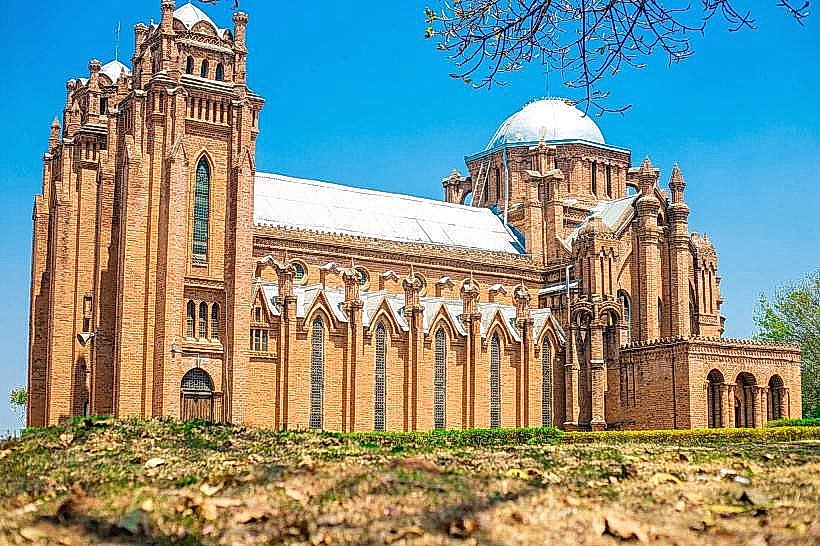
St. Michael and All Angels Church is a historic Anglican place of worship that stands as an architectural monument to the early missionary history of Malawi. The structure is located within the secure mission grounds of the Church of Central Africa Presbyterian (CCAP) Blantyre Synod, positioned along Chileka Road on the western edge of the Blantyre central business district.
Visual Characteristics
The landmark is a massive, multi-tiered red brick cathedral built entirely in a complex eclectic architectural style that merges Byzantine, Romanesque, Gothic, and Moorish design elements. The building features an asymmetrical facade constructed from eighty-one distinct types of locally kilned clay bricks, including intricate molded shapes used for arches, pilasters, and cornices. The structural profile is dominated by twin flanking towers of unequal height, a prominent central dome, a vaulted nave, and multiple semi-circular apses. The interior exhibits dark wood roof timbers, narrow round-arched windows, and a paved stone floor, with the entire external brickwork displaying a characteristic weathered crimson and grey color palette.
Location & Access Logistics
The church is situated approximately 1.2 kilometers west of the Blantyre city center along Chileka Road (M10). Private vehicles access the property via the main gated entrance on Chileka Road, which leads into a paved and gravel parking forecourt inside the secure synod estate. Public transit commuters can utilize any local minibus operating the route between the central Blantyre terminal and Chileka or Limbe, disembarking at the HHI (Blantyre Synod) stop directly outside the perimeter walls. From this transit drop-off point, a 150-meter paved pedestrian walkway leads straight to the main western entrance doors of the cathedral.
Historical & Ecological Origin
The monument was constructed between 1888 and 1891 under the direct supervision of Reverend David Clement Scott, a pioneering Scottish Presbyterian missionary who designed the entire layout despite having no formal training in architecture or structural engineering. The manual labor was executed by local Malawian artisans who kilned the clay from nearby riverbanks and erected the masonry using basic lime mortars and local timber scaffolding. The building holds an exceptional historical classification as the first permanent Christian church structure erected in the region between the Zambezi River and the Nile, serving as a vital cultural nexus during the establishment of the early Blantyre settlement.
Key Highlights & Activities
Visitors can complete self-guided architectural tours around the building's exterior to study the unique patterns of the brick laying, which varies significantly across different structural tiers. Guided historic tours can be arranged through the synod administrative office to gain entry into the interior nave and examine the historic woodwork, clerical plaques, and the elevated pulpit structure. The surrounding landscaped gardens feature old ornamental trees planted during the nineteenth century, providing opportunities for structural photography and quiet contemplation along the brick pedestrian paths.
Infrastructure & Amenities
The facility is equipped with permanent public restroom installations situated in an adjacent administrative block within the synod complex. Abundant shade is provided by the massive overhanging eaves of the cathedral brickwork and the mature tree canopy bordering the lawns, though the immediate front entrance steps are exposed to weather elements. Mobile network connectivity is excellent, with stable 4G and 5G cellular signals blanketing the entire historic site. While no food or beverage vendors operate on the immediate church grounds, several commercial cafes and restaurants are located within a 500-meter radius along the outer edges of Chileka Road.
Best Time to Visit
The optimal window for structural photography and exterior viewing occurs during the mid-morning hours between 08:30 and 11:00, when direct sunlight illuminates the complex eastern apses and brick moldings without causing harsh shadows along the western tower facades. The preferred months for visiting align with the dry winter season from May to August, when ambient temperatures remain comfortable between 16 and 22 degrees Celsius and rainfall risks are low. The building functions as an active place of worship, making weekends highly congested, whereas weekdays provide a quieter environment for architectural study.
Facts & Legends
A remarkable structural fact regarding the construction of the cathedral is that it was erected without a single blueprint, drawing, or architectural sketch on paper; Reverend Scott drafted the dimensions and structural angles daily by directly instructing the bricklayers on the ground using physical measurements and timber frames. Local historical accounts often highlight that the bricks were laid using a mortar mix that allegedly incorporated local wild honey to improve its bonding properties, a technique that has allowed the mortar joints to survive more than 135 years of heavy tropical rain cycles without experiencing structural failure.
Nearby Landmarks
Henry Henderson Institute (HHI) – 0.2km North
Blantyre Sports Club – 0.8km South
Mandala House (La Caverna) – 1.4km Southeast
Chichiri Shopping Mall Complex – 3.2km East
Queen Elizabeth Central Hospital – 1.8km Southeast