Landmark: Pigeon Rocks (Raouche)
City: Beirut
Country: Lebanon
Continent: Asia
Pigeon Rocks (Raouche), Beirut, Lebanon, Asia
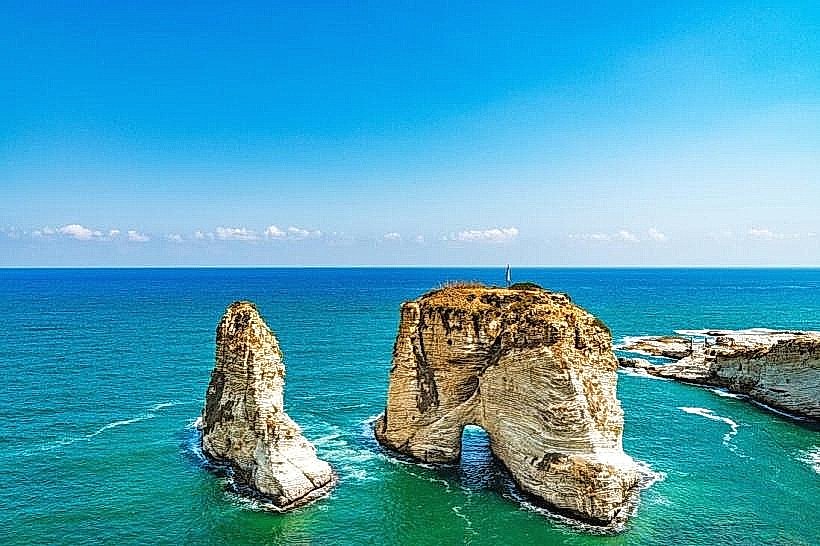
The Pigeon Rocks, also known as Raouche Rocks, are two massive offshore limestone formations situated at the westernmost tip of Beirut, Lebanon. They stand as natural sentinels in the Mediterranean Sea, directly adjacent to the Raouche seaside promenade.
Visual Characteristics
These sedimentary rock structures consist of layered limestone and calcareous cliffs shaped by prehistoric geologic shifts. The largest rock features a distinct natural archway eroded by wave action, allowing small boats to pass through. The surfaces are jagged, pale beige in color, and reach a height of approximately 60 meters above sea level.
Location & Access Logistics
The site is located along the Avenue de Paris (Corniche) in the Raouche neighborhood, roughly 3km west of Beirut’s Central District. Access is via the public sidewalk of the Corniche, which offers elevated viewing platforms. On-site parking is limited to street spots or private underground lots in nearby residential buildings; bus routes 7 and 15 pass frequently along the coastal road.
Historical & Ecological Origin
These formations resulted from marine erosion and tectonic activity during the Miocene epoch. While primarily a geological landmark, the area surrounding the rocks has yielded Paleolithic flint tools, indicating some of the earliest human activity in the Levant. The rocks serve as a nesting site for local seabirds and a waypoint for migratory species.
Key Highlights & Activities
Small motorboats docked at the nearby Dalieh of Raouche provide tours that navigate through the main rock's archway. Walking or jogging along the 4.8km Corniche provides various angles for observation. Diving from the lower ledges is practiced by locals, though it remains unregulated and carries significant risk.
Infrastructure & Amenities
The Corniche is lined with benches and street lighting, though public restrooms are absent from the immediate rock area. 5G mobile coverage is consistent across the entire viewing stretch. Numerous high-rise cafes and restaurants are located across the street from the landmark, offering terrace seating with direct views.
Best Time to Visit
The optimal time for photography is during the "golden hour" shortly before sunset, as the rocks face west and catch the direct evening light. Weather conditions are most favorable from April to June and September to November. Boat access is strictly dependent on sea swells and is frequently suspended during winter storms.
Facts & Legends
Local lore suggests the rocks are the remains of a sea monster turned to stone by Perseus using Medusa’s head to rescue Andromeda. A more modern historical footnote identifies the site as a frequent, grim destination for those seeking to end their lives, leading to the installation of various safety barriers over the decades.
Nearby Landmarks
Dalieh of Raouche (0.2km South)
Ramlet al-Baida Public Beach (1.2km South)
Hamra Street (1.5km Northeast)
AUB Archaeological Museum (2.1km Northeast)
Zaitunay Bay (3.5km Northeast)