Landmark: Cobbe Barracks Clock Tower
City: Zomba
Country: Malawi
Continent: Africa
Cobbe Barracks Clock Tower, Zomba, Malawi, Africa
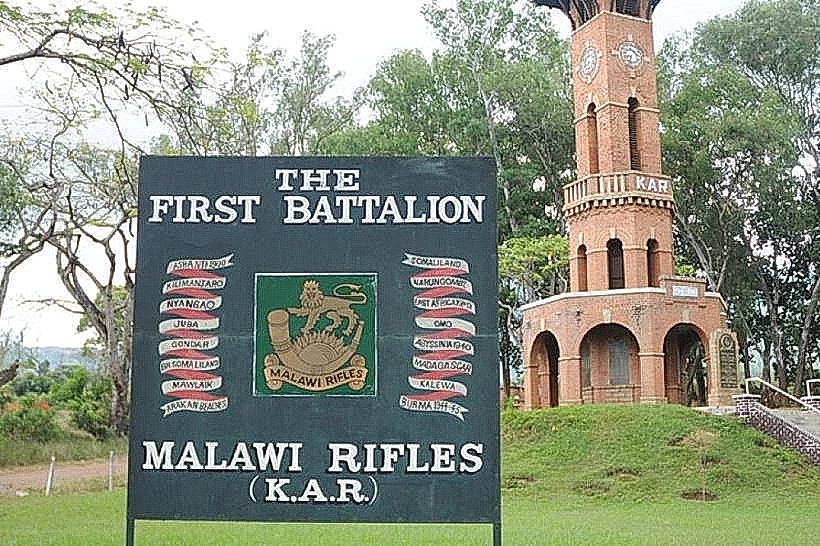
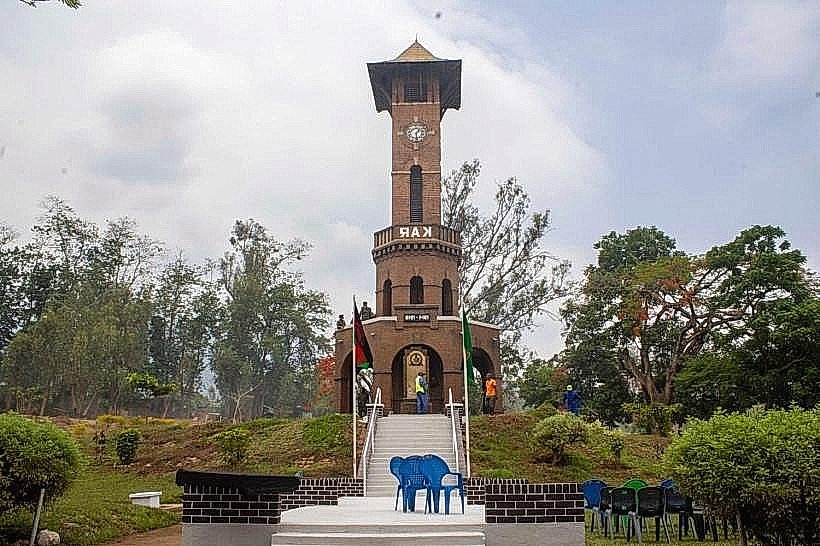
The Cobbe Barracks Clock Tower-structurally identical to and functionally integrated with the King's African Rifles (KAR) War Memorial Tower-is a historic military landmark and state-protected war memorial. Situated within the old colonial capital city of Zomba in Southern Malawi, the tower serves as the definitive World War I monument honoring the native African soldiers (Askari) and logistics porters (Mtengatenga) who died in active service.
Visual Characteristics
The landmark is a prominent 15-meter tall, square-profile structural masonry clock tower executed in the early twentieth-century British imperial commemorative style. The exterior is constructed from coarse, light-grey split granite blocks and reinforced concrete lintels, culminating in a multi-tiered roof housing the original mechanical four-faced clock mechanism. The base of the tower expands into an integrated octagonal brick and stone cloister with an open-arched arcade. The interior walls of this cloister house eight large bronze and brass tablets displaying the official Roll of Honour. The surrounding perimeter is flat, featuring a manicured grass lawn, gravel walkways, and defensive iron perimeter railings.
Location & Access Logistics
The monument is situated approximately 2 kilometers north of the Zomba city center, positioned directly west of the primary M3 (Blantyre-Zomba-Malosa) highway on the approaches to the military cantonment. Private vehicles approach the site from the commercial hub by driving north on the M3, turning left onto the access drive immediately before the Zomba Central Hospital campus. A small gravel parking clearing borders the monument reserve. Public transit commuters can utilize any local high-frequency minibus running the internal Zomba municipal routes, disembarking at the Zomba Central Hospital transit stop. From this drop-off coordinate, the pedestrian walking route to the monument gates measures less than 150 meters heading west.
Historical & Ecological Origin
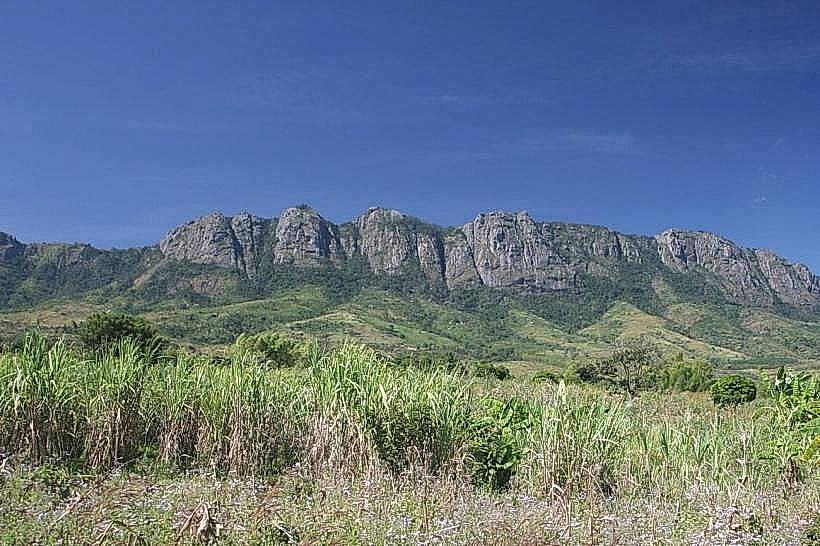
The memorial tower was funded entirely through public subscriptions to honor the veterans of the 1st and 2nd Regiments of the King's African Rifles-a British colonial auxiliary regiment raised across East Africa in 1902. The completed structure was officially unveiled on January 15, 1924, by the Governor of the Nyasaland Protectorate. The surrounding active military facility was formally named Cobbe Barracks in May 1958 in honor of British General Alexander Cobbe, VC, who had served extensively with the KAR. In October 2023, a formal partnership between the Commonwealth War Graves Commission (CWGC), the Malawi Defence Force (MDF), and the Department of Museums and Monuments designated the tower as an official international point of individual commemoration. Geologically, the landmark sits at the southern foot of the massive Zomba Plateau, occupying a well-drained alluvial shelf within the Shire Highlands ecosystem.
Key Highlights & Activities
Historical exploration and architectural photography represent the primary public activities. Visitors can enter the octagonal base cloister to inspect the eight historic brass tablets, which record the names of 1,249 native East African servicemen who have no known graves. The site serves as the central venue for Malawi's national Remembrance Day (Poppy Day) services held annually in November, drawing state executives, MDF military commanders, and international diplomats for wreath-laying ceremonies. The open grounds provide an educational platform utilized by regional schools to study the protectorate's logistical role in the East African and Burma military campaigns.
Infrastructure & Amenities
The monument operates under a low-intervention framework as an open public heritage site. It lacks centralized visitor interpretive centers, commercial gift shops, or permanent public restrooms on the immediate grounds. Partial architectural shade is provided by the wide stone eaves of the lower octagonal cloister and a small cluster of ornamental trees framing the grass perimeter. Mobile telecommunications connectivity is exceptional, with stable 4G and 5G network signals generated directly by the municipal towers of Zomba city. There are no food or beverage vendors allowed inside the monument gates, but comprehensive dining options, pharmacies, and banks are available 500 meters south within the Zomba commercial district.
Best Time to Visit
The optimal period for external structural photography occurs during the morning hours between 08:00 and 11:00, when natural sunlight illuminates the eastern and northern granite faces of the clock tower without causing harsh shadow lines inside the open cloister arches. The preferred months for visiting correspond with the cool, dry winter season from May to August, when ambient temperatures average a comfortable 16 to 21 degrees Celsius and regional humidity is low. The site remains un-gated and accessible to the public during daylight hours seven days a week.
Facts & Legends
The Zomba monument is structurally unique as one of the very few Commonwealth War Graves sites globally to feature a fully integrated operational clock tower rather than a traditional static stone cenotaph or obelisk. Local historiography notes that the placement of the monument was a direct result of Zomba functioning as the absolute headquarters of the King's African Rifles Southern Brigade, making the barracks the foundational military nucleus from which thousands of Malawian soldiers were deployed to international war theaters. The adjacent Cobbe Barracks continues to serve as the active home of the MDF Change Battalion.
Nearby Landmarks
Zomba Central Hospital Campus – 0.5km South
Cobbe Military Barracks Entry – 0.6km West
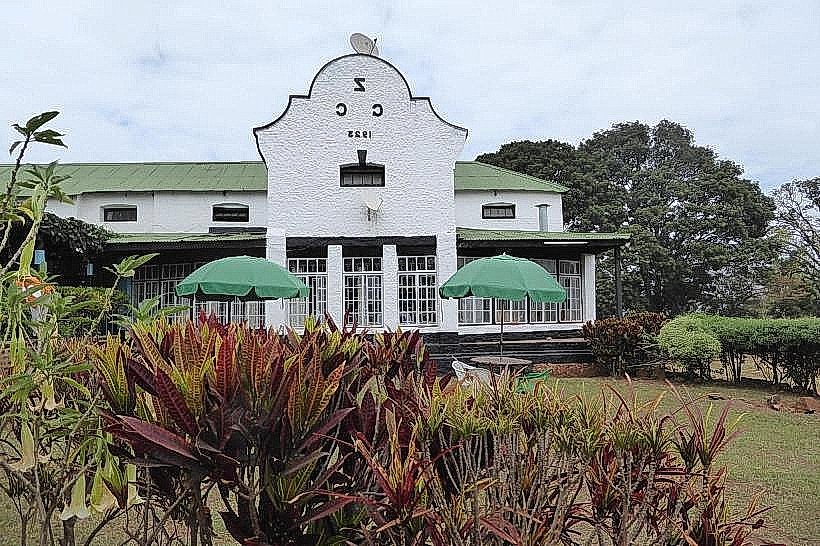
Gymkhana Club Historic House – 2.2km South-Southeast
Zomba Botanical Gardens Base – 2.5km South
Zomba Plateau Rim (Ku Chawe) – 7.5km Northwest