Landmark: Dwangwa Sugar Estate
City: Lilongwe
Country: Malawi
Continent: Africa
Dwangwa Sugar Estate, Lilongwe, Malawi, Africa
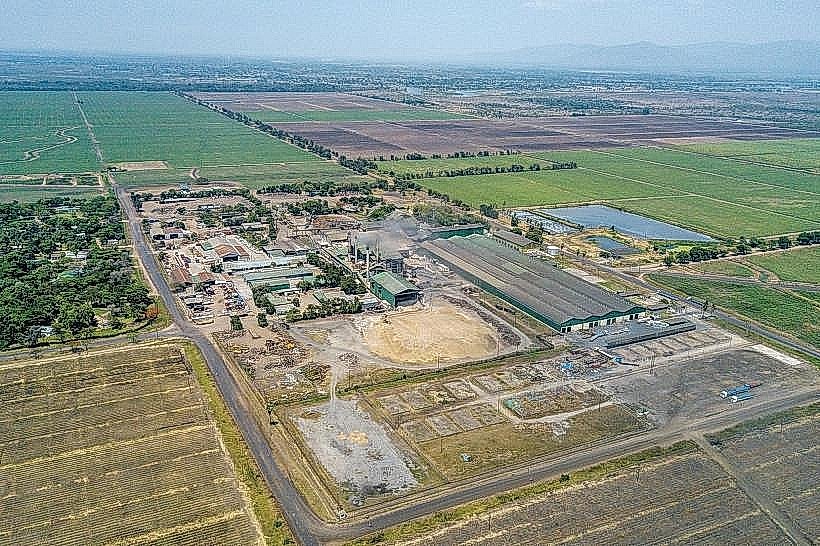
The Dwangwa Sugar Estate is a massive industrial agro-agricultural facility and processing complex that stands as one of the two primary centers for sugar production in Malawi. The property occupies a vast expanse of alluvial lowlands in the northern sector of the Nkhotakota District, bisected into east and west zones by the M5 lakeshore highway.
Visual Characteristics
The landmark is defined by an expansive, grid-like monoculture landscape composed of approximately 13,300 hectares of tightly packed sugarcane fields. The terrain is exceptionally flat and intersected by an intensive network of open concrete irrigation canals, dirt service tracks, and automated overhead sprinkler systems. The industrial epicenter features a large-scale milling and refining factory complex characterized by towering metal smokestacks, corrugated iron warehouses, and large outdoor storage bays for raw cane and molasses. The surrounding worker villages and administrative quarters present a uniform layout of single-story brick housing blocks with corrugated tin roofs, interspersed with mature mango trees and eucalyptus rows.
Location & Access Logistics
The estate is situated approximately 50 kilometers north of Nkhotakota town and 306 kilometers north of the national capital of Lilongwe along the main M5 lakeshore corridor. Private vehicles access the facility directly from the paved M5 highway, which runs straight through the main administrative settlement of Dwangwa, connecting to secure paved and gravel parking areas near the primary sugar mill gates. Public transit commuters can utilize any inter-city bus or shared minibus operating along the Salima-Nkhata Bay lakeshore route, disembarking at the central Dwangwa trading terminal. From this transport drop-off point, the pedestrian walking tracks to the main corporate offices and factory gates measure 1 kilometer heading east.
Historical & Ecological Origin
The industrial enterprise was formalised in 1978 under the name of the Dwangwa Sugar Corporation to scale up national agricultural export output, built on land leased under agreements with regional traditional authorities. The assets were later absorbed by the Lonrho Sugar group before being acquired by Illovo Sugar Malawi plc, which manages the entire infrastructure. Geologically, the estate is situated on a low-altitude, fertile alluvial delta formed by the drainage basin of the Dwangwa River near the western shoreline of Lake Malawi. The tropical savanna climate type allows for high crop yields, requiring intensive water extraction from the river system to feed the massive industrial irrigation framework.
Key Highlights & Activities
The primary public activities center on structured, pre-arranged technical tours through the sugarcane milling and refining factory blocks to observe the mechanized crushing, juice extraction, purification, and crystallization procedures. Visitors can observe large-scale agricultural harvesting operations along the peripheral tracks, including the managed burning of fields and the transit of specialized high-capacity haulage trucks. Birdwatching is active along the drainage canals and effluent ponds on the eastern margin, which attract migratory waterbirds, and the private estate sports clubs host local football and social gatherings.
Infrastructure & Amenities
The industrial township contains structured public infrastructure, including dedicated restroom installations and a staff medical clinic situated near the administrative offices. Dense shade is limited to the residential compound lawns and avenues lined with mature exotic trees, as the active agricultural zones are completely open and exposed to solar radiation. Mobile telecommunications connectivity is highly developed, with consistent 4G network signals active across the refinery and corporate centers, though 5G remains localized. Commercial food and retail options are concentrated at the adjacent Dwangwa trading center, supplemented by a private staff mess hall inside the secure perimeter.
Best Time to Visit
The optimal period for observing the industrial refining process and capturing mechanical photography occurs during the main harvesting and crushing season from May to November, when the factory operates continuously. Morning hours between 08:00 and 10:30 provide favorable ambient lighting and lower temperatures before afternoon heat spikes across the low-altitude plain. The estate curates minimal processing operations during the heavy wet season from December to April, when tropical downpours hamper mechanical harvesting and restrict transit along the unpaved field boundaries.
Facts & Legends
A distinct operational characteristic of the refinery involves its self-sufficient green energy system: the factory processes bagasse-the fibrous woody residue remaining after the sugarcane stalks are crushed-and combusts it in high-pressure boilers to generate steam and internal electricity for the entire milling installation. The estate functions as a vital socioeconomic anchor for the central region, processing raw inputs from thousands of indigenous smallholder out-grower farmers who operate independent agricultural blocks surrounding the core corporate property lines.
Nearby Landmarks
Dwangwa River Delta – 1.8km South
Lake Malawi Western Shoreline – 2.5km East
Ngala Beach Lodge Area – 12.0km North
Nkhotakota Wildlife Reserve Boundary – 48.0km South
Nkhotakota Town Center – 50.0km South